Every successful expedition vehicle eventually reaches a point where its reputation depends upon far more than the engineers who designed it. The first examples leave the production line carrying little more than promise. They may have been tested across deserts, through Arctic winters and over proving grounds intended to expose weaknesses before customers discover them, but no development programme can reproduce the variety of conditions, expectations and mistakes that accumulate once thousands of owners begin travelling independently. Vehicles are loaded beyond the assumptions made during development, adapted for journeys their designers never envisaged and taken into countries where neither the manufacturer nor its suppliers have a meaningful presence. From that moment onwards, a second history begins to emerge, not in engineering reports or laboratory data, but in workshops, recovery yards, owners’ clubs and conversations beside the track. Eventually, that accumulated experience becomes almost as valuable as the vehicle itself.
The most respected expedition platforms all followed that path. Early Land Rovers spread across Africa, Australia and South America long before dependable factory support could follow them. Their reputation was built as much upon the ingenuity of the people who learned to keep them moving when the nearest dealer lay several borders away as it was upon the vehicles themselves. Farmers, military mechanics, missionaries, mining companies and overland travellers gradually discovered which components could be repaired rather than replaced, which failures demanded immediate attention and which apparent catastrophes were little more than inconveniences. Toyota’s Land Cruiser accumulated the same body of practical knowledge over decades of use in environments where reliability was not a marketing phrase but an operational necessity. Independent specialists, parts suppliers and experienced owners slowly created an ecosystem capable of travelling wherever the vehicles themselves could go.
Looking back, that process appears almost inevitable. Today, Land Cruiser and Land Rover owners draw upon decades of workshop experience, independent diagnostic equipment, specialist suppliers and mechanics who have spent much of their working lives understanding these vehicles. Many of the tools now regarded as ordinary began life as one person’s response to a practical problem. Stronger suspension components appeared because somebody overloaded a vehicle. Better roof racks emerged because existing ones failed. Independent workshops grew because owners wanted expertise beyond the dealership. Diagnostic tools such as the IIDTool eventually became as familiar to Defender owners as a socket set or tyre gauge. None of these developments formed part of the original factory specification. They became part of the vehicle’s identity because owners needed them.
It is tempting to remember those years as a simpler mechanical age, although the reality was rather less ideal. Older expedition vehicles leaked oil, demanded frequent adjustment and occasionally broke. The real advantage though was their accessibility. Cause and effect usually remained visible. A failing bearing announced itself through vibration or noise. Cooling problems revealed themselves on the temperature gauge or in the unmistakable smell of hot coolant. Engines still relied upon fuel, air, compression and ignition in ways a confident mechanic could follow with ordinary tools and a methodical approach. The vehicle rarely knew something that remained hidden from the people standing beside it.
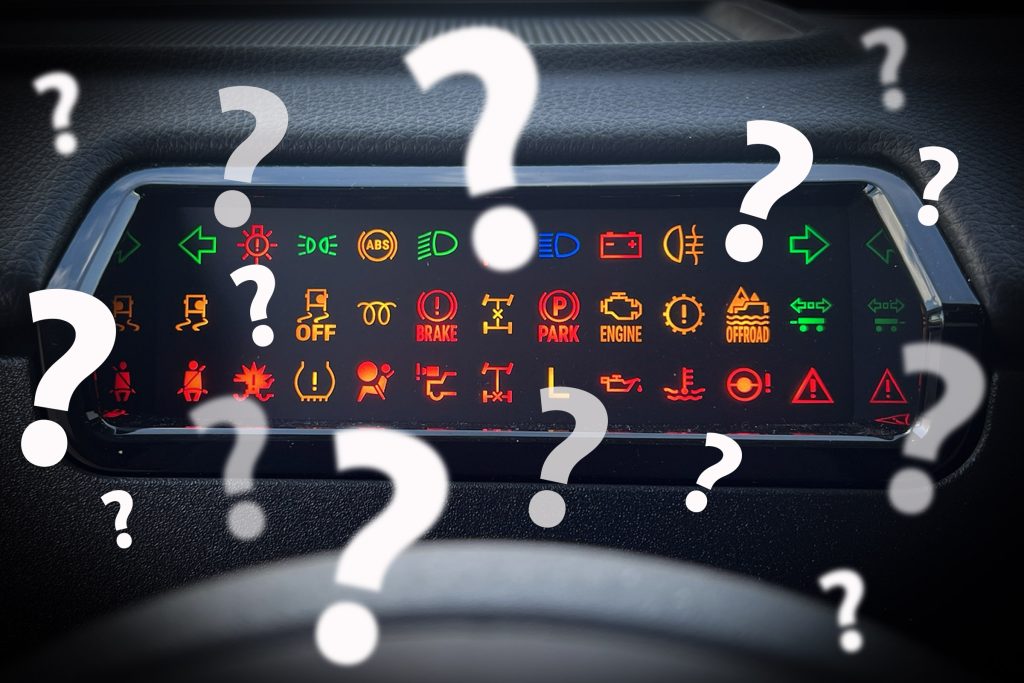
Modern expedition vehicles are immeasurably better engineered. They travel further between services, produce more power from less fuel, meet emissions standards unimaginable thirty years ago and deliver levels of safety their creators could scarcely have imagined. Yet they have introduced a different kind of dependence. The mechanical systems are now shrouded beneath an electronic architecture that observes, interprets and sometimes limits their behaviour. Engines, transmissions, braking systems, emissions controls and safety functions communicate constantly through networks of ECUs. The driver sees only a carefully filtered summary of that activity, usually reduced to a warning symbol, an amber message or a request to visit a workshop. The detail remains inside the vehicle itself, available only to equipment capable of asking the right questions.
This is not the consequence of manufacturers pursuing unnecessary complexity. Even companies determined to build straightforward working vehicles must satisfy emissions legislation, cybersecurity regulations, mandatory safety requirements and increasingly sophisticated type-approval standards. The INEOS Grenadier is perhaps the clearest modern example of a manufacturer attempting to preserve mechanical honesty within those constraints. Ladder-frame chassis, solid axles, physical switches and deliberately conventional engineering reflect a philosophy that places durability and serviceability ahead of fashionable technology. Even so, there is a limit to how simple any new production vehicle can become.
From the beginning, however, INEOS understood something equally important. No manufacturer can anticipate every requirement an expedition vehicle will encounter once it leaves the production line. Rather than treating the Grenadier as a closed product, the company made engineering information available to third-party manufacturers. Suspension specialists, roof-rack companies and accessory designers were able to develop equipment around the platform with confidence that it would integrate correctly with the vehicle. The result has been one of the fastest-growing accessory markets seen around a new expedition platform. Long-range equipment, storage systems, recovery accessories, protection components and expedition conversions appeared remarkably quickly … not because INEOS attempted to build everything itself, but because it recognised that the strength of an expedition vehicle lies partly in the community that develops around it.

The question surrounding the Grenadier has never really been whether it could cross a continent. Owners began answering that almost as soon as the first vehicles entered service. Expeditions appeared with remarkable speed and owners demonstrated that the vehicle possessed the strength, ride quality and durability expected of a modern long-distance platform. Perhaps one of the clearest answers came when John Balsdon completed his recent record-breaking Cape-to-Cape expedition from Nordkapp in Norway to the southernmost point of Africa. Whatever questions remained about the Grenadier’s ability to endure immense distances across changing climates, borders and terrain were answered not by marketing material, but by a vehicle that had already done precisely that.
Performance is one thing, confidence is another. The ability to cross a continent means little if an unexpected warning light hundreds of kilometres from the next workshop leaves the driver unable to judge whether the journey can safely continue. Whereas the simpler expedition vehicles of yesteryear revealed their problems, the Grenadier often knows more about its condition than its owner, because uncertainty in the first instance is less mechanical than it is informational.
Decades of accumulated owner and workshop experience benefit the earlier Land Cruisers and Land Rovers. The Grenadier on the other hand, entered the world carrying only the experience accumulated during its own development programme and the support network that INEOS itself could reasonably establish. That network continues to grow, but no manufacturer can position authorised workshops wherever serious expedition travel eventually leads.
This is where the modern expedition vehicle differs fundamentally from its predecessors. The mechanical competence required to repair it may already exist almost anywhere in the world. The Grenadier’s engines come from BMW, the automatic gearbox from ZF, the transfer case from Tremec, the axles from Carraro and the braking system from Brembo. None of those names is unfamiliar to experienced workshops. A capable mechanic in Central Asia, southern Africa or South America may understand perfectly well how those components function and possess years of practical experience repairing similar systems. What remains unfamiliar is the electronic architecture connecting them together.
A warning displayed on the dashboard does not identify the problem directly. It simply informs the driver that one or more control units have detected something outside their expected operating parameters. The event may be trivial: a temporary voltage fluctuation during starting, an interrupted emissions procedure or a sensor reading that returned to normal almost immediately. It may equally represent the first indication of a fault demanding urgent attention. The information required to distinguish between those possibilities exists, but, until now, has been locked inside the vehicle. Once the authorised workshop disappears over the horizon, access to that information frequently disappears with it.
That gap between mechanical capability and diagnostic independence has become one of the principal questions surrounding the Grenadier. The vehicle is capable, yet a degree of scepticism still endures at the thought of the nearest dealer lying several days away. Confidence has never depended upon believing that a vehicle will not fail. Every experienced overlander knows better than that. What it does boil down to though, is understanding what has happened, deciding intelligently what to do next and knowing where an investigation should begin. And this is precisely the moment when Dieter Reuter offers some clarity.
Our previous conversation centred on a surprisingly modest objective. Dieter was not attempting to reproduce the official INEOS workshop system or unlock every function within the Grenadier’s electronic architecture. His aim was simply to help himself understand what his own vehicle was trying to tell him.
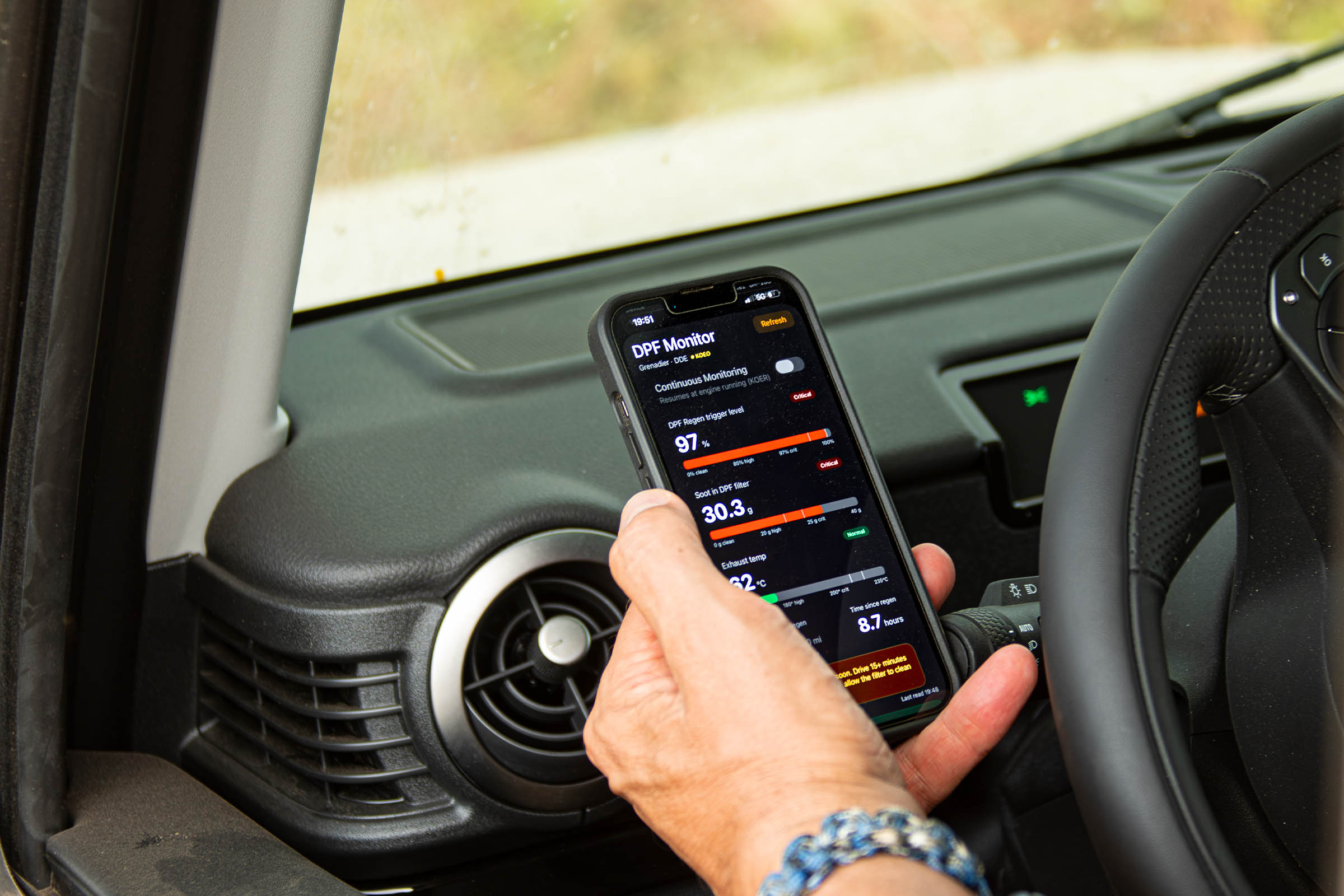
Since then, the project has evolved considerably. What began as one programmer’s response to a practical problem is now being used by more than four hundred Grenadier owners across different countries, climates and driving conditions. Every journey adds something new. Unfamiliar warning patterns appear, owners suggest improvements and additional functions are developed in response to real-world experience rather than theoretical requirements. Recent Apple CarPlay integration is one example, bringing selected diagnostic information directly onto the vehicle’s own infotainment screen. The app is no longer a prototype awaiting validation, it has become a practical tool that continues to mature alongside the Grenadier itself.
There is, however, a broader significance. From the outset, INEOS had encouraged independent companies to develop bolt-on accessories for the Grenadier platform because they understood that no manufacturer can anticipate every requirement an owner will encounter. Independent diagnostic capability is therefor a logical extension of that same philosophy. Like every successful expedition vehicle before it, the Grenadier is beginning to acquire support from the people who use it.
Dieter is himself a seasoned overlander and fully aware equipment intended for remote travel should remain useful wherever the journey leads. So it comes as no surprise that his app does not rely on a mobile signal, Wi-Fi connection or communication with a remote server. Once installed on an iPhone or iPad and paired with a compatible Bluetooth OBD interface, it travels with the vehicle. Whether the Grenadier is parked outside an authorised workshop in Germany, on a station track in the Australian interior or beneath the high passes of Central Asia, it works. Simple as that.
Its operation reflects the same strategy. ECUs record almost everything, including events that may have corrected themselves long ago. A temporary voltage drop during starting, an interrupted diesel particulate filter regeneration or a sensor that briefly reports an implausible value can all leave entries behind long after the underlying condition has disappeared. Reading those entries, preserving them, clearing them and observing what returns often reveals far more than the warning light alone.
One Australian owner encountered precisely that situation. An engine warning light went on deep in the outback, even though the Grenadier itself continued to drive normally. The app was connected, the stored entries were preserved and the history cleared. Nothing returned. No repair had taken place because none proved necessary, yet the uncertainty disappeared. Instead of wondering whether the warning represented the beginning of a more serious problem, the owner could continue with considerably more peace of mind because the vehicle itself no longer regarded the event as active.
But that’s not the end of the story. Rather than relying upon the driver’s recollection of a warning symbol seen days earlier, the app’s stored report could be sent ahead before the vehicle reached a workshop. An authorised INEOS technician could review the information in advance. An experienced auto-electrician might recognise patterns associated with voltage irregularities or interrupted communication between control units. The report does not replace diagnosis, but it gives those carrying it out a far better place to begin.
Another example that occurred in South Africa involved a Grenadier that eventually required recovery from Zimbabwe to Pretoria before the underlying cause was traced to a failed starter battery. Significantly, a replacement battery of the correct specification was already being carried in the vehicle. It would be tempting to conclude that access to the stored diagnostic information would have prevented the recovery, but the available evidence does not allow such certainty. The facts, however, are revealing enough. An ordinary component had failed and the correct replacement happened to be on board. The difficulty lay in identifying the problem while the vehicle was still in the field. Once again, the obstacle was not the mechanical repair itself, but understanding where the investigation should begin.
A similar lesson emerged much further from home. The Pamir Highway has earned its reputation because it still demands a degree of self-sufficiency from those who travel it. Workshops exist. Skilled mechanics exist. Generations have kept machinery operating under conditions that encourage repair rather than replacement. Yet none of that experience automatically provides access to the information stored within a modern vehicle’s control units.
When one Grenadier developed a significant fault, local mechanical knowledge was never really the limiting factor. Advice travelled between countries. Spare parts and a specialist were even flown in. Alas, the vehicle eventually crossed international borders before the failed control unit responsible for the problem was identified in Germany using the appropriate diagnostic equipment.
Once again we circle back to the fact that 21st century expedition vehicles have not become less mechanical, they have become more dependent upon understanding their electronics before mechanical experience can be applied effectively. Bearings, shafts, pumps and electrical connections still fail for perfectly ordinary reasons. Increasingly, however, the first challenge is identifying which system deserves attention.
That is also why a generic OBD scanner provides only part of the picture. Standard protocols make emissions-related information available, but the Grenadier consists of numerous control units communicating continuously with one another. A warning displayed on the dashboard may originate within the engine, transmission, braking system, body electronics or from the interaction between several of them. Looking at only one part of that network risks producing an incomplete diagnosis.
Dieter’s objective has never been to replace an authorised workshop or change any of the factory settings and programming. Instead, it has been to give owners access to enough of the vehicle’s own information to make better decisions while they remain beyond the INOES infrastructure.
The app continues to evolve in response to those practical requirements. Live data has become one of its most valuable additions because it allows owners to observe processes while they are taking place rather than waiting for a fault to be stored afterwards. Diesel particulate filter regeneration provides a good example. Slow off-road driving, prolonged idling or repeated short journeys may interrupt regeneration without immediately producing a warning. Instead of guessing whether the process has completed successfully, owners can observe what the vehicle is actually doing and respond accordingly.
By now, the pattern is becoming clear. The Grenadier is no longer dependent solely upon the diagnostic capability that leaves the factory with it. Like the Land Cruiser and the Land Rover before it, it is beginning to acquire an independent body of knowledge that travels wherever owners choose to take it.
If you want to know more, you can find Dieter Reuter on Facebook or reach out to him directly by email: dieter.reuter@me.com
Related reading: INEOS Grenadier Diagnosis: Understanding What the Electronics Are Really Saying.