The road into Würzburg was wet when we arrived. Not dramatic rain. Just that lingering grey drizzle that settles over southern Germany and turns industrial estates into places most people drive through without ever really seeing. Warehouses. Loading bays. Forklifts. Anonymous concrete. The sort of landscape where practical things are made quietly while the rest of the world obsesses over marketing departments, social media strategies, and influencer reels.
Inside QOOL’s headquarters, however, the atmosphere shifted almost immediately. Calm. Ordered. Focused. Not sterile in the corporate sense, but precise. The entrance hall carried none of the noise and chaos often associated with outdoor lifestyle brands trying to sell adventure through neon colours and oversized slogans. There were no giant photographs of smiling people beside alpine lakes. No walls covered in pseudo-expedition clichés. Instead, there was a glass meeting room where products, vacuum panels, thermal discussions, testing procedures and manufacturing processes were about to be discussed … the subjects engineers discuss when solving a problem properly is more important than making it marketable.. That detail was not particularly surprising, because QOOL did not begin life as an outdoor brand at all.
That much becomes obvious within minutes of speaking to Moritz von Wysiecki, co-founder and managing director of the Würzburg-based company. The further the conversation develops, the clearer it becomes that the cooling boxes now slowly finding their way into overland vehicles, sailing boats, and campsites across Europe were never originally intended for beers on a beach or food storage in the back of a van. Their roots lie somewhere far less glamorous, but infinitely more demanding: pharmaceutical transport.
“Ten days controlled cooling without electricity sounds unbelievable to most people,” Moritz admitted at one point during our conversation. “The biggest challenge is not just building the technology. The biggest challenge is explaining it.”
And therein lies the real story behind QOOL. Because the modern outdoor market has become deeply conditioned to think about cooling in a very specific way. Compressors. Lithium batteries. Solar panels. Charging systems. Larger alternators. More capacity. More cables. More monitoring. More management. More complexity. Entire vehicle builds are now often designed around feeding electrical systems that only a decade ago many travellers would have considered luxuries rather than necessities.
Open the rear door of many modern expedition vehicles and you are just as likely to find a rolling electrical substation as you are camping equipment.
QOOL walked in the opposite direction. Not backwards. Not nostalgically. Not by reviving the old world of flimsy styrofoam boxes and melting supermarket ice. Quite the opposite. Their approach was rooted in highly specialised temperature stability systems developed for environments where failure simply was not acceptable.
Long before QOOL existed, the underlying technology was already being used in thermal transport systems for pharmaceutical logistics. Vaccines, medical products, and temperature-sensitive goods moving through freight networks where precise temperature ranges had to be maintained consistently, repeatedly and, most importantly, provably. In that world, marketing promises mean absolutely nothing. Temperature performance must be validated, documented, and repeatable under tightly controlled conditions.
“The pharma industry tests everything extremely carefully,” Moritz explained. “Not just internally. Products are validated through independent laboratories and qualification procedures. Performance claims have to be proven.”
That mindset still defines the company today. It also explains why QOOL products feel strangely different from much of the outdoor market. Not visually. In fact, the boxes themselves are relatively understated. At first glance, they do not scream “extreme expedition equipment” in the way many consumers have been conditioned to expect. No military styling. No tactical nonsense. No exaggerated overlanding aesthetics. In a market increasingly obsessed with making camping equipment resemble hardware for a lunar expedition, QOOL products appear almost deceptively simple. Which, ironically, became one of the company’s first major challenges.
“We came from a B2B pharmaceutical background,” Moritz said. “Not from the end consumer market. So, naturally, people compare the box visually with traditional cooler boxes and don’t immediately understand what is actually inside.”
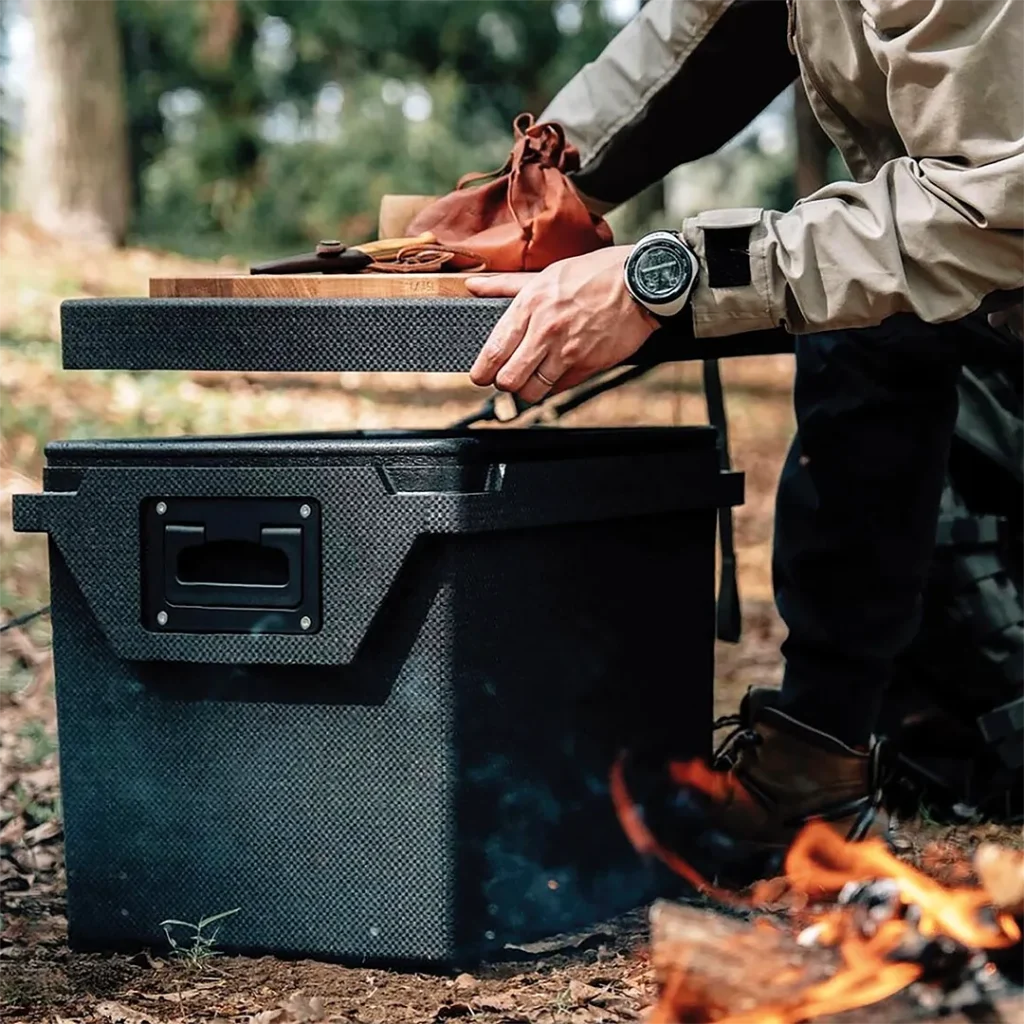
That misconception is significant because the technology hidden inside the walls of a QOOL box is fundamentally different from traditional passive cooling systems. During our talk, Moritz explained the principle by comparing it to a vacuum flask, a concept everyone already understands. The difference is that while a thermos bottle or mug works in a cylindrical form, QOOL had to adapt vacuum insulation into flat structural panels capable of forming a complete insulated cube without thermal bridges.
The challenge with vacuum insulation panels is structural. Once a vacuum is created, the outer layers naturally want to collapse inward under atmospheric pressure. The solution lies in a specialised core material within the panels themselves. In QOOL’s case, an ultra-fine mineral structure Moritz casually referred to during our conversation as “nano sand” prevents the panels from collapsing while maintaining exceptionally high insulation performance. The result is a cooling system capable of maintaining remarkably stable temperatures for prolonged periods without external power. But insulation alone is only half the story.
The second half lies in the company’s temperature elements. Specialised cooling cartridges containing proprietary thermal compounds rather than simple frozen water. These elements effectively define the operating temperature inside the box itself. Depending on the chosen cartridges, the system can function as either a refrigerator or a freezer while remaining entirely passive. And importantly for real-world travel, these systems were adapted around ordinary consumer deep freezers rather than industrial equipment.
That detail may sound small, but it reveals something fundamental about the company’s philosophy. The original pharmaceutical technologies could achieve significantly lower temperatures, but often required storage conditions far beyond what normal users have access to. QOOL instead adapted the technology for realistic outdoor and recreational use.
Their “Frozen” elements, for example, can be charged inside a normal household freezer running at approximately minus eighteen degrees Celsius and still maintain temperatures cold enough for frozen food and ice cream. The refrigeration elements work in a narrower range between minus two to plus two degrees … cold enough to keep food and drinks properly chilled without freezing milk solid or turning butter into masonry.
This controlled temperature stability is perhaps the least understood aspect of the system, but arguably the most important.
Traditional ice-based cooling systems fluctuate constantly. Compressor systems cycle repeatedly as temperatures rise and fall. QOOL instead delivers stability. A concept inherited directly from pharmaceutical logistics.
“When pharmaceutical products are transported,” Moritz explained, “the important thing is not just cold temperatures, but maintaining a specific temperature band consistently.”
During our discussion, we repeatedly drifted away from marketing language and back toward the practical realities of long-distance travel. Medical supplies. Food stability. Energy independence. Reliability. Real-world usability. And gradually another question began emerging beneath the technical explanations: How much complexity do we actually need?
Motorcycle travel had already taught me something many modern overland builds seem to forget: extensive travel does not necessarily require extensive systems. On a motorcycle, you naturally learn to prioritise. Space is limited. Weight matters. Reliability matters even more. Every unnecessary complication eventually becomes something else waiting to fail hundreds of kilometres from the nearest workshop.
That philosophy changes the way you evaluate equipment.
The question shifts from “What is technically possible?” to “What do I genuinely need?”
Modern overland vehicles increasingly drift toward larger electrical systems feeding larger appliances, increasing dependence on charging systems, battery management, monitoring equipment, and increasingly complicated vehicle electrics. Much of it works brilliantly. But complexity has a habit of quietly multiplying itself until the system itself becomes part of the expedition burden.
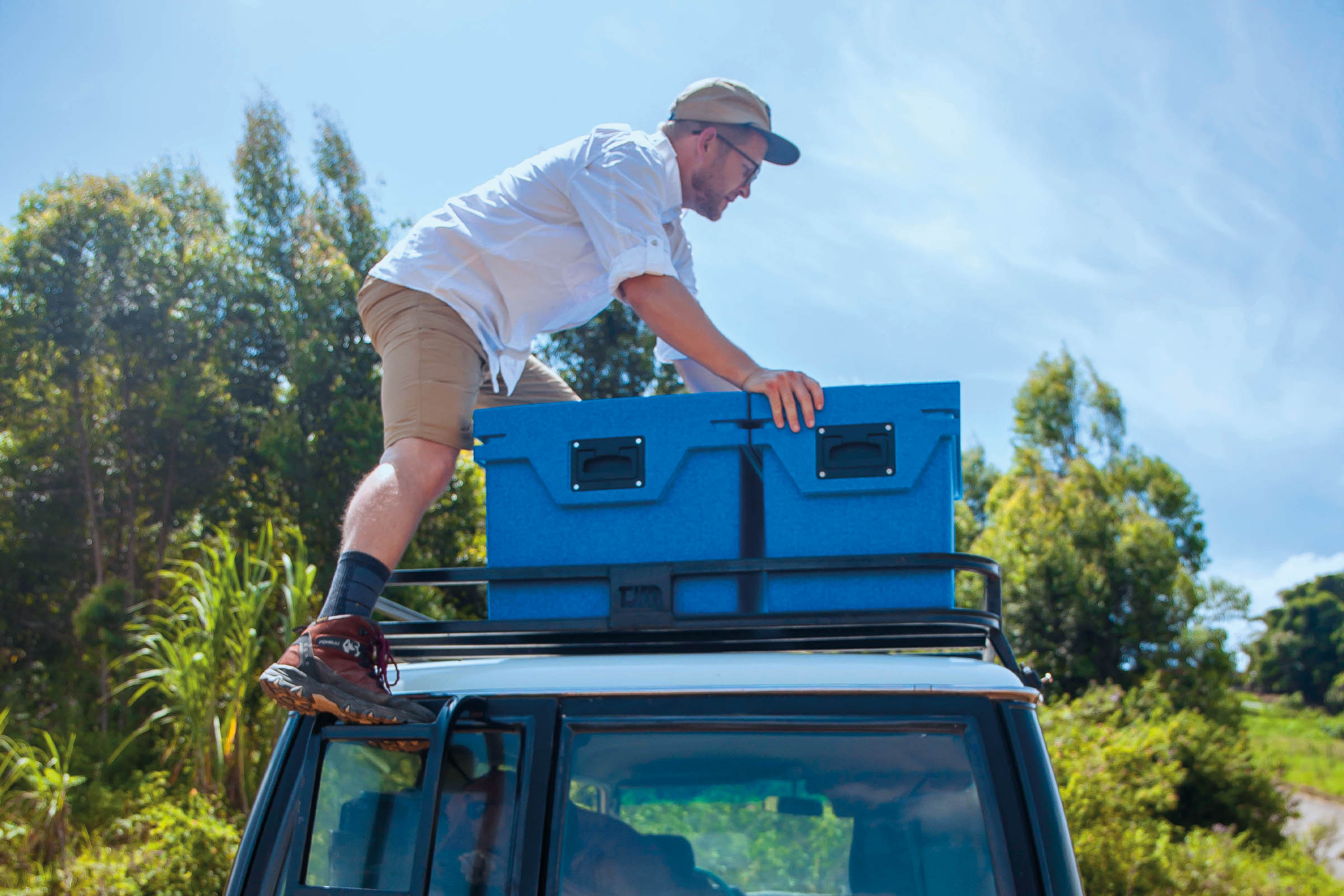
QOOL challenges that accepted logic in a surprisingly intelligent way. Not because compressors are wrong. Moritz himself openly acknowledges that compressor systems remain entirely logical for many travellers. But the company increasingly appeals to people searching for flexibility, redundancy, and a degree of independence from permanent electrical dependency. Additional cooling without additional power consumption. Stable temperatures during electrical failure. Cooling that can be removed from the vehicle entirely and carried onto a beach, into a tent, onto a sailboat, or deep into a remote camp without requiring cables or generators.
All of this becomes particularly interesting once you stop viewing the product purely as a “coolbox” and instead begin viewing it as part of a broader travel philosophy.
One of the more revealing moments in the conversation emerged when discussing customer behaviour. Conventional wisdom would suggest that highly durable products with ten-year guarantees generate limited repeat business. Moritz laughed slightly when I mentioned it.
Initially, the company assumed exactly the same thing. In reality, many customers return. Not because the products fail, but because their usage evolves. One cooling system becomes two. A vehicle setup expands into a boat. A weekend solution becomes part of a long-term travel setup. Additional temperature ranges are added. The ecosystem slowly broadens.
And perhaps most tellingly of all, much of the company’s growth now comes through word of mouth rather than marketing campaigns. Moritz described trade fair encounters where existing customers effectively interrupted sales conversations to explain the products to sceptical newcomers themselves. He smiled while recounting it, still slightly amused by the reactions.
“People sometimes look at them as if we paid them,” he laughed.
That sort of advocacy cannot easily be manufactured. Especially not in the overland world, where experienced travellers tend to become deeply suspicious of exaggerated marketing claims and carefully curated social media narratives. Equipment either works consistently over time or it does not. There is very little middle ground once vehicles leave Europe’s motorways behind. And perhaps that is ultimately why QOOL feels interesting beyond the products themselves.
The company sits at an unusual intersection between industrial engineering, pharmaceutical transport technology, and autonomous travel. It approaches cooling not as a lifestyle accessory but as a practical systems problem requiring stability, reliability, and efficiency. The technology was not invented to look adventurous or be a scroll-stopper on Instagram. It was developed because temperature-sensitive cargo genuinely needed to remain temperature stable.
The outdoor market merely discovered that the same logic also makes a surprising amount of sense beside a mountain track in the Pyrenees, on a sailboat crossing the Adriatic, or somewhere deep inside an expedition vehicle far beyond reliable infrastructure.
But interesting concepts and polished explanations only go so far. Ultimately, products like these have to survive the realities of travel itself. Heat. Dust. Packing compromises. Repeated use. Real-world abuse. Long days on rough roads. Practicality. Simplicity. Convenience. Reliability over time.
And that is where the next stage begins. Because, while the engineering story behind QOOL is undoubtedly fascinating, the real question now is whether this approach genuinely offers a credible alternative once it leaves the laboratory, the showroom, and the production floor behind.
That question deserves proper testing. Not marketing demonstrations. Not controlled influencer trips. Proper comparison under repeatable conditions against established alternatives. And beyond that, something arguably even more important: long-term integration into the realities of actual travel.
The concept itself is certainly compelling. Now comes the interesting part.