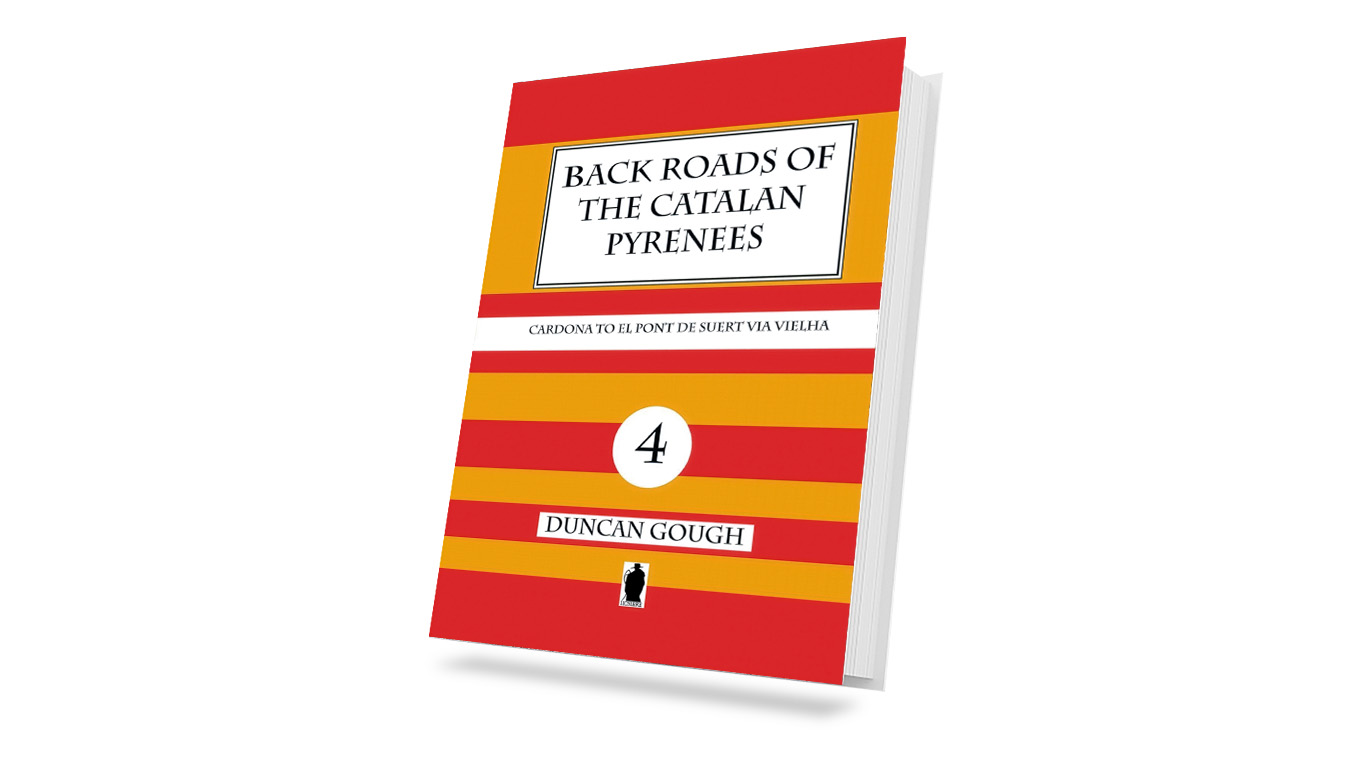
By Duncan Gough
ISBN 978-0995745483
A Personal Guide to Slowing Down
There are guidebooks that tell you where to go, and then there are those that quietly change how you travel. Back Roads of the Catalan Pyrenees: Cardona to El Pont de Suert by Duncan Gough sits somewhere in that space between instruction and reflection. It is not a glossy, data-heavy manual, nor is it a pure narrative in the traditional sense. Instead, it reads like something more personal: part route guide, part field journal, and part extended conversation with a man who has spent decades moving slowly through Iberia, paying attention to the things most travellers pass by without noticing.
A refreshing approach, because from the very first pages it becomes clear that this is not a book concerned with ticking off destinations or compressing experience into an efficient sequence of highlights. It works against that instinct. What Gough offers instead is a way of travelling that prioritises awareness over speed, interaction over itinerary, and understanding over simple movement.
Gough’s background—farming, engineering, theatre design, travel writing—reveals itself not through grand statements but through the way he observes the world. The opening section, Ways of travelling, is arguably the most important part of the book, setting the tone for everything that follows. Here, he challenges the idea that travel is defined by arrival, quietly dismantling the modern obsession with endpoints and replacing it with something more grounded. He encourages conversations with locals, attention to the rhythms of daily life, and an interest in how places function beneath the surface. It is not idealised advice; it is practical, almost disarmingly so. Say thank you. Learn how people greet each other. Notice how towns are built and why they take the shape they do. These are simple ideas, but rarely applied with any consistency, and it is in that gap that the book finds its relevance.
At its core, the guide follows a defined route from Cardona to El Pont de Suert, broken into manageable stages that move logically through the landscape. Distances, road numbers, and navigation notes are all present, giving the journey a clear structure on paper. In practice, however, the route functions less as an objective and more as a thread … a loose spine that holds the narrative together while allowing space for the real substance of the book to unfold. A turn-off glimpsed on a Michelin map becomes a reason to explore. A stretch of mountain road chosen for its “wiggles” turns into a highlight in its own right. A café stop becomes an unexpected moment of connection, and a small village opens a window into history and daily life. The journey is not imposed on the reader; it evolves, gently, as you move through it.
One of the guide’s quiet strengths lies in the details that do not immediately announce themselves. Practical observations are woven into the narrative in a way that feels natural rather than instructional. Fuel stops that are easy to miss, road surfaces worn down by timber lorries, the reality of narrow mountain passes where tourist coaches appear without warning. These are the kinds of insights that only come from repetition and experience. They are not presented as checklists or bullet points, but absorbed almost subconsciously as you read. It is knowledge earned through time spent in the landscape, and it fills a gap that more polished, commercially driven guides often leave untouched.
The historical context is handled with a similar sense of restraint. References to Cathar routes, Roman settlements, the scars of the civil war, and the rise and decline of small industries are all present, but never in a way that overwhelms the reader. Instead, they add texture, giving depth to the landscape without slowing the journey. You are offered just enough to understand where you are and why it matters, before being allowed to move on. It is a careful balance, and one that the book maintains with a quiet confidence.
Where the guide becomes more distinctive—and where it may divide opinion—is in its personal layer. Gough writes as he travels, recording small observations, fleeting encounters, and moments that carry no obvious relevance to the route itself but linger nonetheless. A scooter rider passes by in a negligée with complete composure. Children set off fireworks in a village square while adults look on, unconcerned, as if the outcome has already been decided. These moments do not advance the journey in any practical sense, but they bring it to life in a way that purely functional guides rarely achieve. They serve as a reminder that travel is not a sequence of waypoints, but a collection of impressions, most of them unplanned and impossible to replicate.
For all its strengths, the book does ask something of the reader. Its structure is deliberately loose, and while that lends it a certain charm and authenticity, it also means that information is not always immediately accessible in the way modern travellers have come to expect. This is not a guide you skim quickly at the side of the road to make a fast decision; it rewards time and attention, and in return offers a deeper sense of place. The visual presentation follows a similar logic. Long paragraphs dominate, and while the hand-drawn maps and sketches add character and reinforce the personal nature of the work, they prioritise atmosphere over precision. For some readers, particularly those accustomed to highly structured, system-driven guides, this may require a small adjustment in approach.
It is also worth noting that the guide remains largely road-focused, with a natural bias toward motorcycle travel. While it hints at broader possibilities and occasional detours, it does not attempt to provide a comprehensive overlanding framework with detailed vehicle requirements, camping strategies, or logistical systems. Yet, this feels less like an omission and more like a conscious decision. The book is clear about what it wants to be, and it remains consistent in that intent throughout.
What it does, perhaps better than most guides, is slow the reader down … not through instruction, but through tone. There is no urgency in these pages, no pressure to optimise or maximise. Instead, there is a steady encouragement to stop, to look more closely, and to allow the journey to unfold at its own pace. It makes a quiet case for using a paper map, for asking directions, for taking the occasional wrong turn and seeing where it leads. In a landscape increasingly shaped by algorithms and efficiency, that approach feels almost quietly defiant.
In the end, Back Roads of the Catalan Pyrenees is not a guidebook in the modern, system-driven sense. It is closer to a companion. Something you read before a journey, return to along the way, and reflect on afterwards. It will not replace your map, nor will it attempt to dictate your route. What it offers instead is a shift in perspective, a reminder that how you travel matters as much as where you go. For the right reader, that is not just useful … it is enduring.