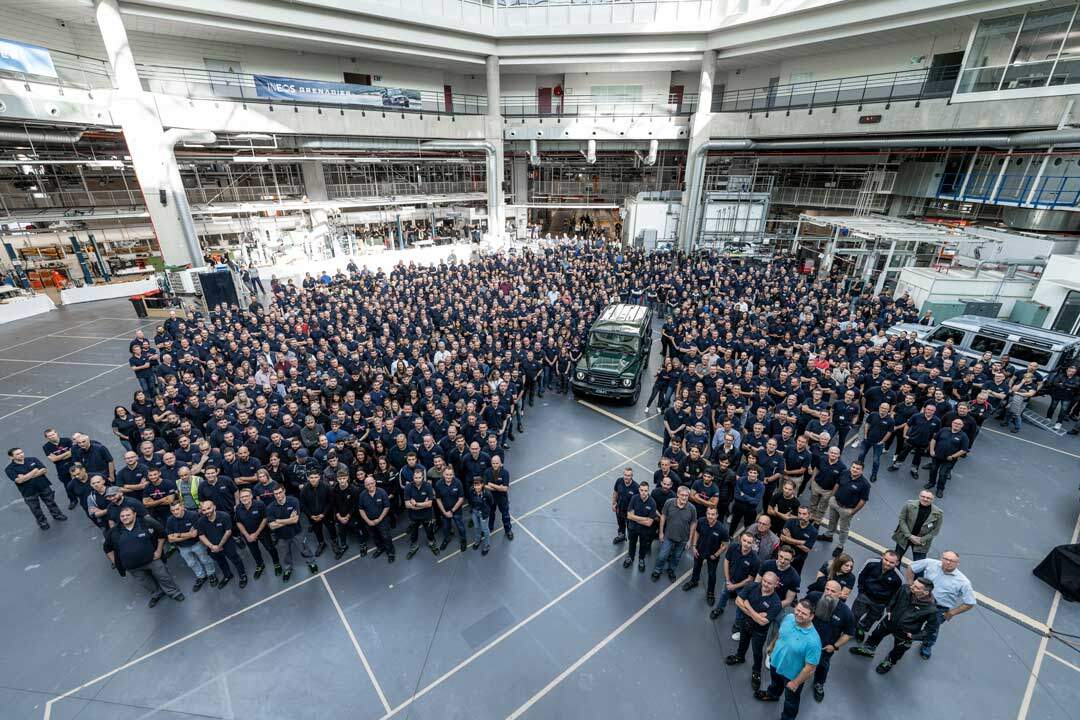
Feature image: Hambach, October 2022: the workforce gathers around the first series-production Grenadier. Photo: INEOS Automotive.
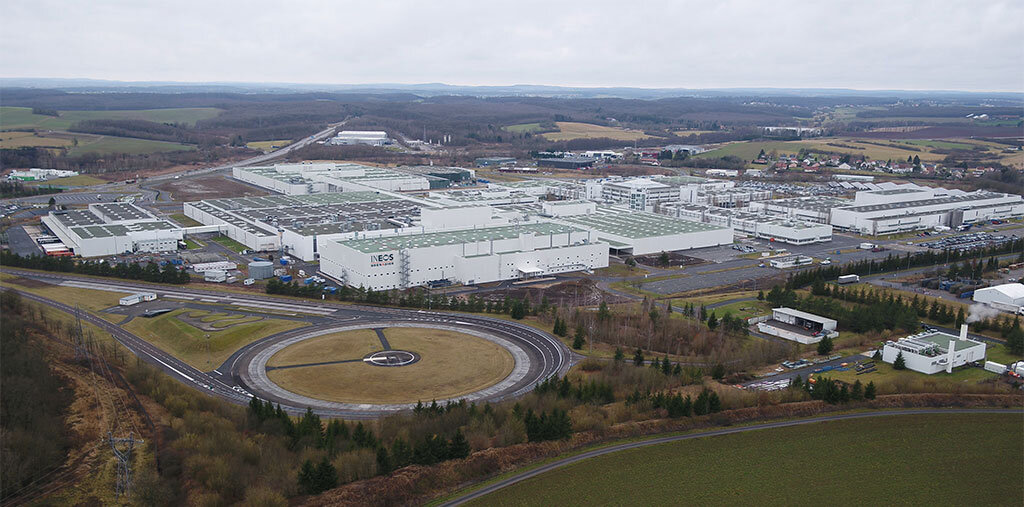
Hambach sits in the Moselle, a short drive from the Saarland border, in a practical landscape where factories are built rather than admired. Mercedes-Benz made the Smart there for more than twenty years. The Grenadier itself came out of a refusal. When Land Rover stopped building the Defender at Solihull in January 2016, Jim Ratcliffe asked Jaguar Land Rover to sell him the tooling so that production could go on. It declined, so he set out to build his own, named after the pub in Belgravia where the idea took shape over a pint. The first plan was to build it in Wales, at a new plant in Bridgend announced in 2019. In 2020 INEOS dropped Bridgend and bought Hambach instead, and in October 2022, as OverlandEurope reported at the time, the first series-production Grenadier rolled off a line that Mercedes had re-equipped only three years earlier.
On 24 November 2026 INEOS announced that the Grenadier and the Quartermaster pick-up will be built in the United States from 2028. The company has shortlisted sites, most likely an existing plant rather than a new one, expects to make a final decision within months, and gives a plain reason: the US accounts for 70 percent of Grenadier sales worldwide. Further down the same release came the second half of the story: INEOS is in exclusive negotiations to sell Hambach to BYD. If those talks succeed, the release says, the Grenadier and Quartermaster “would continue to be produced at Hambach for the medium term”. BYD confirmed the talks the same day, saying it wants to build vehicles there designed for European drivers. The deal remains subject to consultation with the plant’s works council, which represents more than 1,200 employees. In an email to customers the following morning, Lynn Calder, INEOS Automotive’s chief executive, said the company aims to complete the sale in the first quarter of 2027.
The numbers explain the decision better than the press release does. In April 2025 INEOS raised its American prices by up to 11 percent to pass on part of the new tariffs. By August, with registrations falling, it had cut them by as much as $8,500 to win buyers back, accepting a further hit to its margins. For the Quartermaster the sums were worse still: as an imported pick-up it has paid the 25 percent American “chicken tax” from the start, a duty that disappears once it is built in the US. Calder’s email points to a recovery, with worldwide sales in the first nine months of 2026 almost 15 percent ahead of the same period in 2025. Hambach was set up to build around 30,000 vehicles a year, but L’Usine Nouvelle estimates that it built about 9,500 in 2025, a figure INEOS has not confirmed. Calder had already said that the company would follow the industrial rule of building where you sell, and INEOS is open about what tipped the balance. “US trade policies have incentivised onshore investment in manufacturing,” it told OverlandEurope. On the figures alone, nobody in a boardroom would argue with Calder.
The people who will argue are the ones who carried the brand in its first years. The Grenadier was sold in Europe as the honest heir to the old Defender, a ladder-frame, beam-axle vehicle for people who actually go somewhere, and the first customer cars went to European and British owners almost a year before American deliveries began. Buyers on both sides of the Atlantic paid deposits before the production car existed, and the Americans waited a year longer for theirs. For many Europeans, part of the attraction was that this successor to the Defender would be built in Europe. Those owners bought into a factory, a promise and a story. Their cars were built in France. The next generation of European owners will buy one built in America: INEOS confirmed to OverlandEurope that once Hambach stops, all of its global production will be in the US and shipped from there to every market.
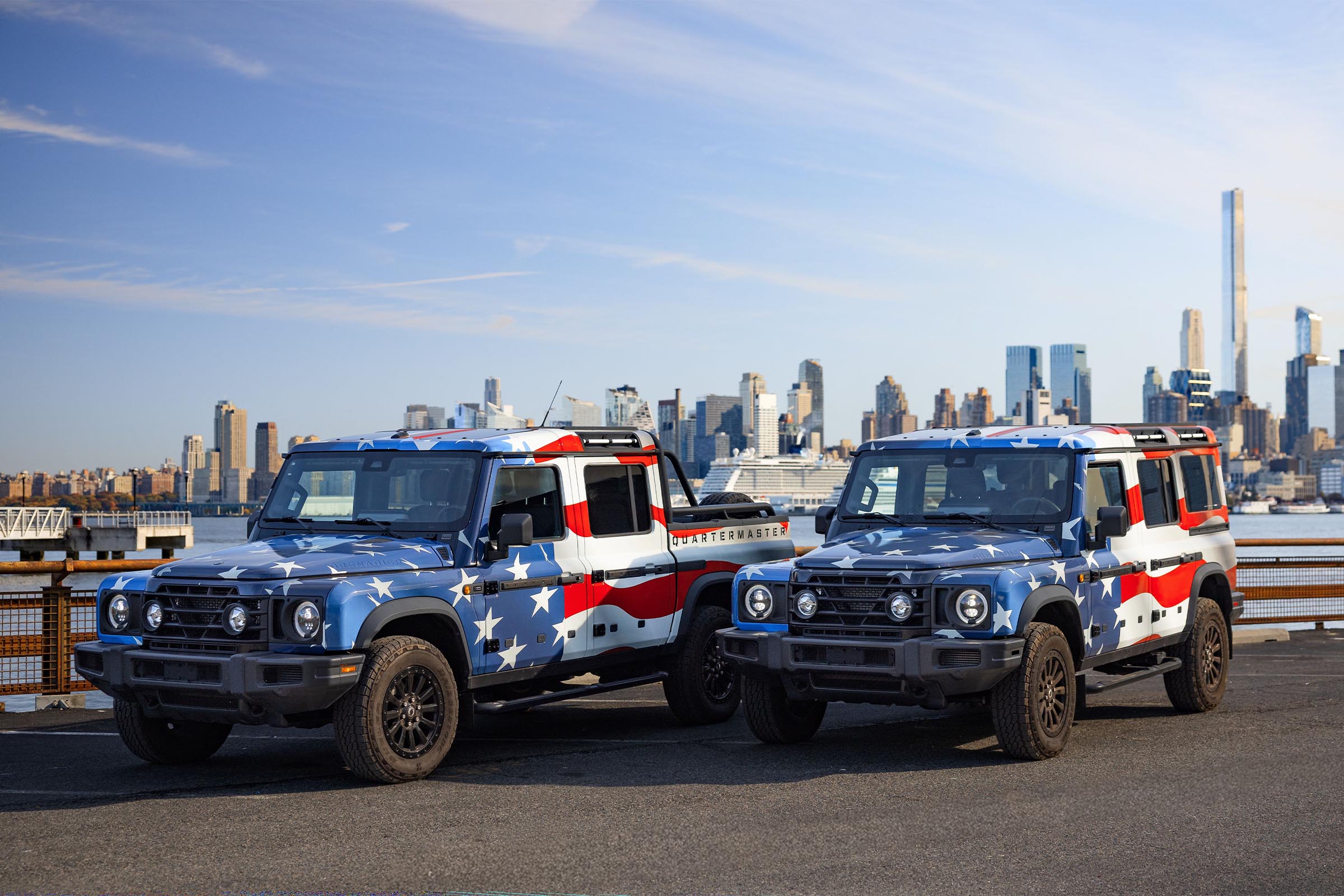
The move cannot be framed simply as Hambach good, America uncertain. Hambach has had its own troubles. In 2024 a seat supplier’s bankruptcy stopped the line for four months, and more than 7,000 Grenadiers were recalled in the United States after doors were found able to open while the vehicle was moving. INEOS says that if the factory sale goes through, the Grenadier will be built “on the same line, by the same workforce, with the same parts from the same suppliers to the same quality standards”, although it cannot yet say what its arrangement with BYD will be. The BMW engines stay, and the existing suppliers will be invited to follow the car to America. The fair question isn’t whether quality will drop without Hambach. It’s what happens during a new plant’s teething years, and who checks the build at Hambach once INEOS no longer owns it.
There is a further constituency the announcement does not mention. This autumn the Grenadier finally broke into defence. The Italian Army placed what INEOS calls a substantial order, and the Austrian government ordered enhanced-protection versions; both are in production at Hambach now. In Britain, the Team Grenadier consortium is bidding for the Army’s Light Mobility Vehicle programme, the replacement for the Land Rover and the Pinzgauer, and has made much of its European credentials: vehicles built in France, converted in the UK, with more than 90 percent of the supply chain in Britain and Western Europe. INEOS would not say where LMV vehicles would be built after 2028. Earlier this month, Der Spiegel reported that the Bundeswehr was turning certain BYD, Nio and Geely models away from sensitive military sites over what their cameras and sensors might record. Asked whether its defence customers would accept vehicles from a BYD-owned plant, INEOS said it had been in touch with all its critical customers and that their priority was capability, reliability and service in the field. It did not say whether any of them had raised the question. A European defence ministry that will not let a BYD hatchback through the barracks gate will at least want to know who owns the building where its vehicles are assembled, and a vehicle built in America makes a different case from the one Team Grenadier put forward in the summer.
The dealers face the same uncertainty. In Germany the network has grown since launch, but some early partners have already handed the franchise back. In Sweden, new Grenadiers are being advertised at up to 300,000 kronor below list price. INEOS’s answer to dealers and owners is that nothing changes. Hambach will fill orders worldwide until the American plant is running, the standard warranty in most markets remains five years, and dealers, parts, servicing and customer care will carry on as “business as usual”. The company forecasts no adverse effect on residual values. Asked whether import duties and homologation will push up the price of a US-built Grenadier in Europe, it said only that the car “will remain extremely good value”.
What INEOS cannot yet say is how long the medium term lasts. Asked how many years Hambach will go on building Grenadiers, it said negotiations were ongoing. Asked whether production in France and America would overlap, so that European dealers are not left waiting for cars, it called that the best-case scenario and said it was far too early to commit. That is the gap European owners and dealers will be watching. INEOS says it is not considering selling INEOS Automotive or bringing in a partner, although future models are likely to share a technology platform with another manufacturer.
The Grenadier began as one man’s refusal to let a working vehicle disappear when Solihull stopped building it. From 2028 it will be built in America, for the Americans who buy most of them, and for everyone else as well. In Europe, where the story started, the owners are left with the cars, and with a factory that will soon belong to someone else.