There is a danger with success in the compact SUV market.
Build something too soft and it disappears into the background noise of urban crossovers. Build something too serious and customers walk straight past it towards something easier to park outside a supermarket.
The original Jeep Avenger managed to avoid both traps. It arrived with proper Jeep character compressed into a footprint small enough for European cities, while still offering genuine rough-road credibility many rivals only pretend to possess. Now, with more than 270,000 orders already behind it, Jeep has returned with an updated version that sharpens the formula rather than reinventing it.
And frankly, that was probably the sensible decision.
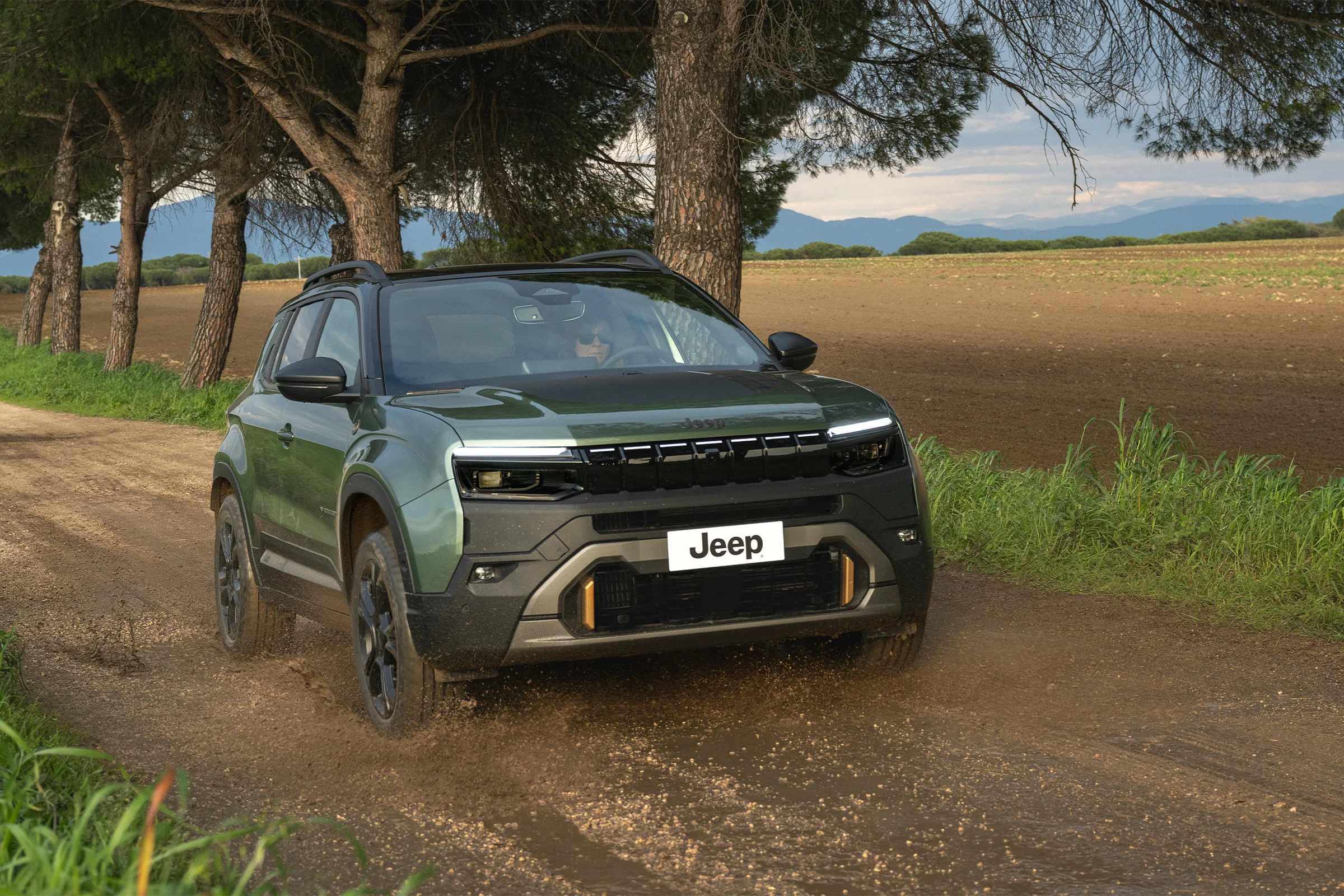
The new Avenger still sits firmly in the compact B-SUV category, but Jeep has clearly spent time refining the details owners actually notice after living with a vehicle for a few years. The styling changes are subtle rather than theatrical, yet they push the Avenger closer towards the rest of the modern Jeep family. The illuminated seven-slot grille, inspired by the larger Compass, gives the front end more presence at night and helps distinguish it in traffic without drifting into gimmick territory.
Elsewhere, practicality remains central to the design philosophy.
The cladding, moulded skid plates, and protected lighting units are not there purely for show. Anyone who regularly squeezes through narrow village streets, rocky tracks, or crowded city car parks will understand why these details matter. Small knocks happen. Jeep knows it. The Avenger has been designed accordingly.
The revised bumpers strengthen that protective feel, while new wheel designs and two fresh colours, Forest and Bamboo, continue the brand’s habit of linking its vehicles to the outdoors rather than the urban jungle alone. A black roof option adds a little visual contrast without overcomplicating things.
Inside, Jeep has focused heavily on improving perceived quality. Softer materials on the doors, a padded lower dashboard, revised upholstery, and more durable finishes suggest the company understands that compact SUVs are no longer judged purely on practicality. Buyers now expect small vehicles to feel genuinely premium.
Importantly, the Avenger still retains the functional touches that make it useful beyond school runs and commuting. The square rear load area remains practical. Interior storage totals up to 34 litres. The reversible cargo floor can be cleaned easily after muddy boots, wet dogs, or camping gear have been thrown in the back.
And yes, the Selec-Terrain system survives the update. That matters more than it might first appear.
Many compact SUVs talk about lifestyle while quietly panicking at the sight of gravel. The Avenger continues to offer surprisingly serious geometry for a vehicle of this size, with up to 210 mm of ground clearance and respectable approach and departure angles. Hill Descent Control and Selec-Terrain remain standard across the range, reinforcing the idea that this is still a Jeep first and a crossover second.
Technology receives one of the largest upgrades.
New LED matrix headlights arrive alongside a 360-degree camera system capable of digitally reconstructing the vehicle’s surroundings during parking manoeuvres. In crowded European cities, where alloy wheels often survive only weeks before meeting granite kerbs, systems like this quickly move from luxury to necessity.
Underneath, Jeep continues its broad powertrain strategy.
Rather than forcing buyers towards one solution, the new Avenger offers almost every drivetrain currently relevant in Europe. Traditionalists can still choose the new 1.2-litre Turbo 100 petrol engine paired with a six-speed manual gearbox. Hybrid buyers receive the 110 hp e-Hybrid with automatic transmission and limited low-speed electric running capability.
Those wanting something more capable off-road will inevitably gravitate towards the 145 hp 4xe version, which combines electrification with all-wheel drive and serious rear axle torque delivery. Jeep claims the system can still climb steep loose surfaces even when front axle grip disappears completely — exactly the sort of engineering detail that separates proper traction systems from marketing exercises.
At the other end of the spectrum sits the fully electric version producing 156 hp, offering up to 400 km WLTP range alongside rapid charging capability.
In many ways, this freedom of choice may be the Avenger’s greatest strength.
Some manufacturers have become so focused on electrification targets and platform sharing that customers are simply expected to adapt. Jeep seems to understand that European buyers remain divided. Some want petrol simplicity. Some want hybrid efficiency. Others want full electric silence. The Avenger allows all of them to coexist under the same badge.
The new Turbo 100 petrol engine deserves particular attention because it quietly addresses several concerns buyers increasingly raise about small turbocharged engines. Jeep emphasises durability, reduced maintenance intervals, improved efficiency, and the switch to timing chain operation. More importantly, the engine reportedly endured over 30,000 hours of testing during development.
That sort of detail matters to people who actually keep vehicles beyond finance cycles.
The trim structure also appears sensibly organised. Longitude, Altitude, and Summit cover the front-wheel-drive range, while the more rugged 4xe variants arrive as Upland and Overland models. Even the entry-level vehicles receive full LED lighting, automatic climate control, cruise control, wireless smartphone integration, and Jeep’s connected services system.
Then there is the anniversary edition.
To celebrate 85 years of Jeep, the company has created a dedicated Avenger special edition featuring gold-finished wheels, tartan detailing, illuminated grille treatment, unique upholstery, and various heritage-inspired touches. It could easily have become overdone, but from the details released so far it appears Jeep has managed to walk the line between nostalgic and tasteful reasonably well.
Ultimately, the updated Avenger succeeds because Jeep resisted the temptation to overcomplicate the formula.
This is not a radical reinvention. It is a careful evolution of a compact SUV that already understood its audience surprisingly well. The improvements focus on usability, quality, technology, and choice rather than headline-grabbing theatrics.
And in a market increasingly filled with vehicles trying desperately to imitate adventure without fully understanding it, that restrained confidence may be exactly why the Avenger continues to resonate.