Every expedition vehicle earns its reputation in the same place.
Not beneath the bright lights of a motor show, nor in glossy brochures filled with carefully staged photography, but somewhere much further away. A mountain pass where the weather turns without warning. A desert track that disappears over the horizon. A river crossing where turning around is no longer an option. Places where the nearest workshop is measured not in kilometres but in days, and where the person behind the wheel quickly discovers the difference between capability and confidence.
Those two words are often treated as though their meaning were the same. They are not.
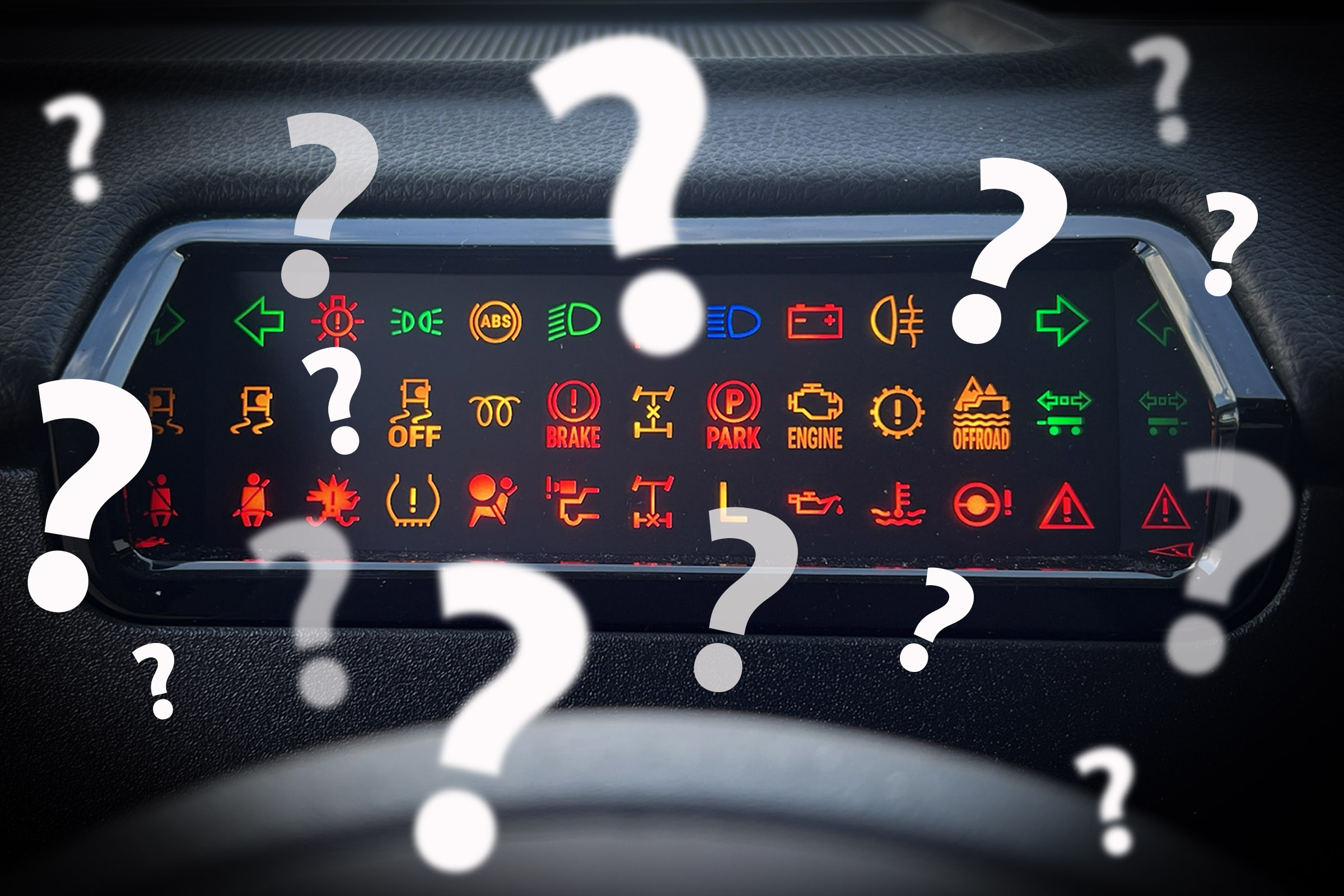
A vehicle may be capable of extraordinary things, yet still leave its owner wondering what happens if a warning light persists halfway across Namibia. Equally, a comparatively modest vehicle can inspire enormous confidence simply because its driver understands it well enough to make informed decisions when something unexpected occurs. Expedition travel has never been about eliminating uncertainty. It has always been about reducing it.
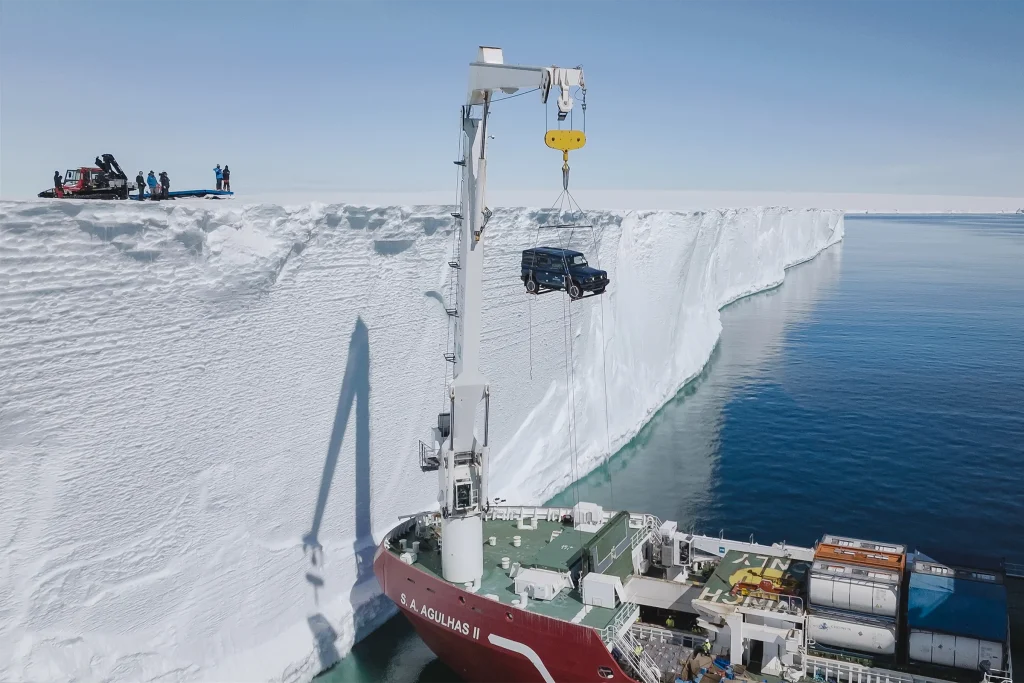
The INEOS Grenadier has already answered many of the questions surrounding its mechanical capability. Since vehicles first reached the customer, they have crossed continents, climbed mountain passes, worked on farms, served emergency organisations, and covered hundreds of thousands of kilometres in environments that would challenge far more established four-wheel drives. Most recently, John Balsdon and his team demonstrated the platform’s remarkable physical resilience during their record-breaking Cape-to-Cape expedition, driving from Nordkapp to Cape Agulhas under conditions few vehicles will ever experience.
Listening to Balsdon describe weeks of corrugated roads, overloaded suspension, punishing heat and relentless distances, one impression emerged above all others. The Grenadier simply kept going. For many owners, that statement settles an important question. For me, however, another one remained.
It surfaced during a conversation with Dieter Reuter, a Grenadier owner from Germany whose professional life has been spent developing software, but whose motivation for beginning what has become one of the most interesting independent projects in the Grenadier community had remarkably little to do with programming. Instead, it began with travel.
Like many experienced overlanders, Dieter understands that modern vehicles bring extraordinary capability at the cost of increasing complexity. His own garage reflects that evolution. Alongside the Grenadier sits a Land Rover Discovery 4, accompanied by a GAP IIDTool that has become essential equipment for many a long-distance Land Rover traveller. It is not carried because owners enjoy studying fault codes; it travels with the vehicle because making sense of what the electronics are trying to communicate can mean the difference between continuing a journey or ending a journey prematurely. Just like any other spanner, torque wrench or jack, it’s part of the overlanding tool kit.
When the Grenadier arrived, Dieter assumed a similar solution would eventually appear. After all, this was a vehicle was conceived by Sir Jim Ratcliffe and his team from the outset as a serious expedition platform. It had been engineered to carry heavy loads, cross difficult terrain, and operate in some of the harshest environments on earth. Surely someone would develop a practical way for owners to understand the increasingly sophisticated electronics that lay beneath its deliberately uncomplicated exterior.
He waited.
Announcements were published. Rumours circulated. Ideas appeared on forums before quietly disappearing again. Yet, the one thing Dieter wanted never materialised. His requirements were surprisingly modest. He did not want to rewrite software or unlock hidden functions. He had no ambition to compete with Bosch or reproduce the sophisticated diagnostic equipment used by authorised service centres. He simply wanted a dedicated tool that could travel with him, work entirely offline, and explain what the vehicle was trying to tell him if something unexpected happened hundreds or even thousands of kilometres from the nearest workshop. After almost three years, his patience had worn thin.
“If nobody else is building the tool I actually need,” he told me, “I’ll build it myself.”
That single commitment says rather a lot about the project that followed. It also reveals an important fact about the Grenadier itself. Every successful expedition vehicle eventually develops an independent support network around it. Manufacturers design and build remarkable machines, but the knowledge that allows those machines to travel confidently around the world rarely comes from the factory alone. It grows slowly through owners, mechanics, specialists, and enthusiasts who encounter real problems in real places and begin solving them.
Land Rover did not create the IIDTool. Toyota did not establish the worldwide network of independent Land Cruiser specialists. Those communities emerged because travellers discovered needs that only became visible once vehicles had left the safety net of an urban environment and begun exploring the world. The Grenadier is simply beginning the same journey, albeit under rather different circumstances.
Forty years ago, a breakdown somewhere in Morocco would have become the centrepiece of a story shared around a campfire or printed months later in the newsletter of an owners’ club. By then, somebody had usually discovered a solution, and the problem quietly became part of the collective knowledge surrounding the vehicle. Today, information travels rather faster. A photograph of a warning light posted from Portugal can circle the globe as fast as bits and bytes can travel. By lunchtime, it has accumulated hundreds of comments ranging from decades of genuine experience to little more than educated guesswork. Before the day is over, one owner has declared a fundamental design flaw while another insists they have covered fifty thousand fault-free kilometres without the slightest concern. Useful knowledge and misinformation now travel at exactly the same speed. The Grenadier is going through precisely the same process that every successful expedition vehicle has experienced before it. Only this time, everyone is watching.
Dieter’s background undoubtedly gave him a head start, but it was not the reason I found myself listening so carefully. His professional life has been spent solving complex technical problems. Yet, throughout our conversation he repeatedly steered away from the technology itself. Every time we drifted towards CAN bus architecture, encrypted communication or electronic control units, he gently brought the discussion back to the same place … travel. There is no shortage of diagnostic tools capable of reading fault codes from modern vehicles. Most are designed for workshops or experienced technicians, and others promise features that few owners will ever use. Dieter had no interest in either approach. His software would have to satisfy a far simpler brief:
- It had to work completely offline.
- It had to run on an ordinary iPhone or iPad connected to an inexpensive Bluetooth OBD adapter.
There would be no requirement for a mobile signal, cloud services or subscriptions. Once installed, it had to function wherever the vehicle happened to be, whether that was a supermarket car park in Germany or a remote piste somewhere beyond the Atlas Mountains.
Owners using Android devices should not immediately dismiss the idea because the app only requires iOS 16 or later and a perfectly capable refurbished iPhone or iPad is now widely available for less than the cost of filling the Grenadier’s fuel tank. Considering the role the software could eventually play on a major expedition, it wouldn’t be out of the question to keep a dedicated device in the vehicle, in exactly the same way a Land Rover owner has an IIDTool.
The second requirement was even more interesting.
“This isn’t about changing the system,” Dieter explained. “It’s about understanding it.”
Those ten words, and the differentiation between changing and understanding, became the recurring theme of our conversation.
Modern vehicles are extraordinarily sophisticated machines. Manufacturers quite rightly are bound to protect the integrity of that complexity. Functional safety, cybersecurity, emissions legislation, warranty obligations, and product liability all depend upon carefully controlling who can alter a vehicle’s electronic systems, and how those systems are accessed. Handing unrestricted diagnostic authority to every owner would create responsibilities no manufacturer could reasonably accept. Dieter understands that perfectly well and his objective is not to bypass those safeguards but to work alongside them. The application concentrates on reading information, interpreting what the vehicle is reporting, and presenting that information in a form owners can actually understand. Rather than encouraging experimentation, it encourages informed decision-making.
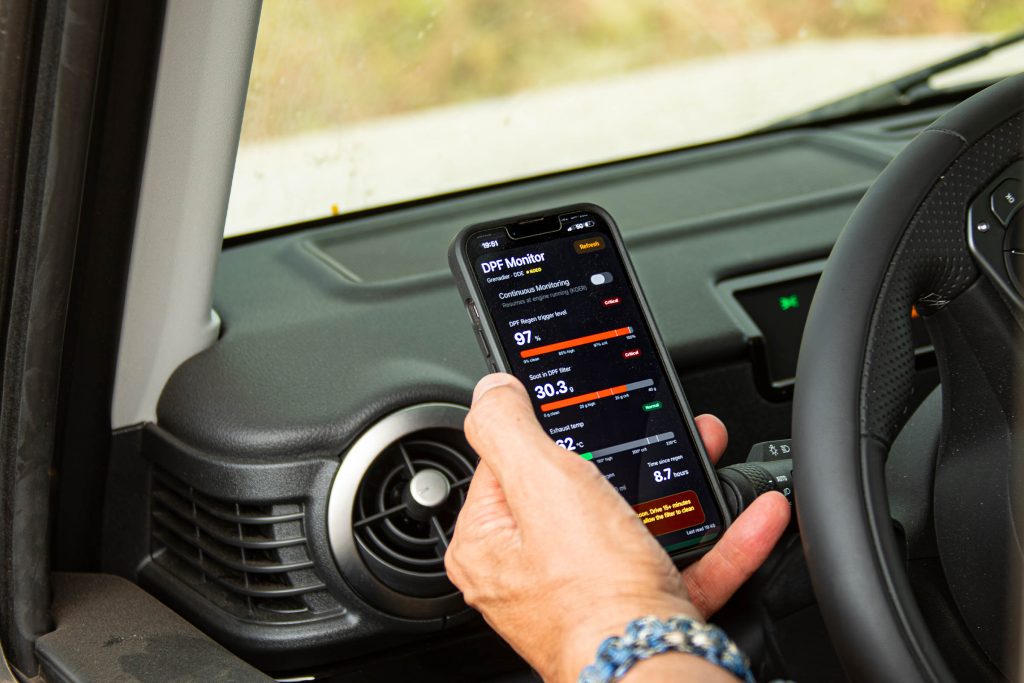
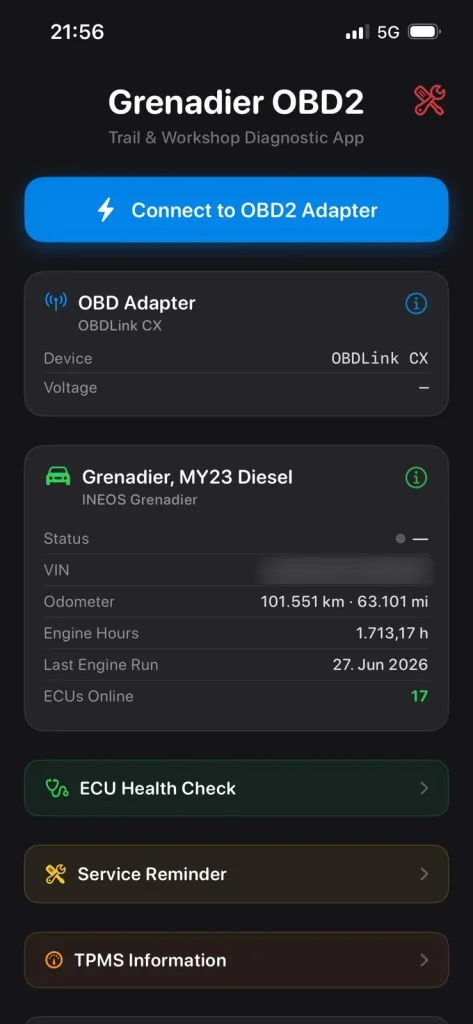
Screenshots and real-time video from the app Click any image to enlarge.
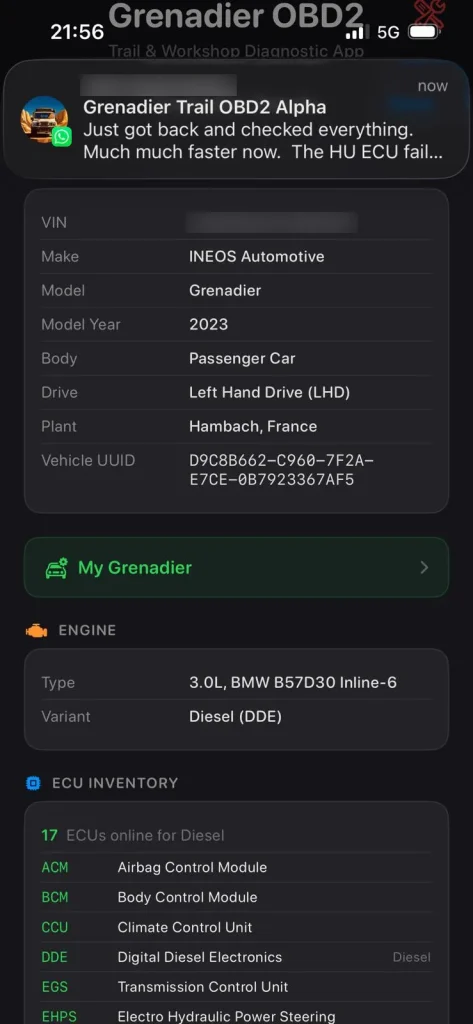
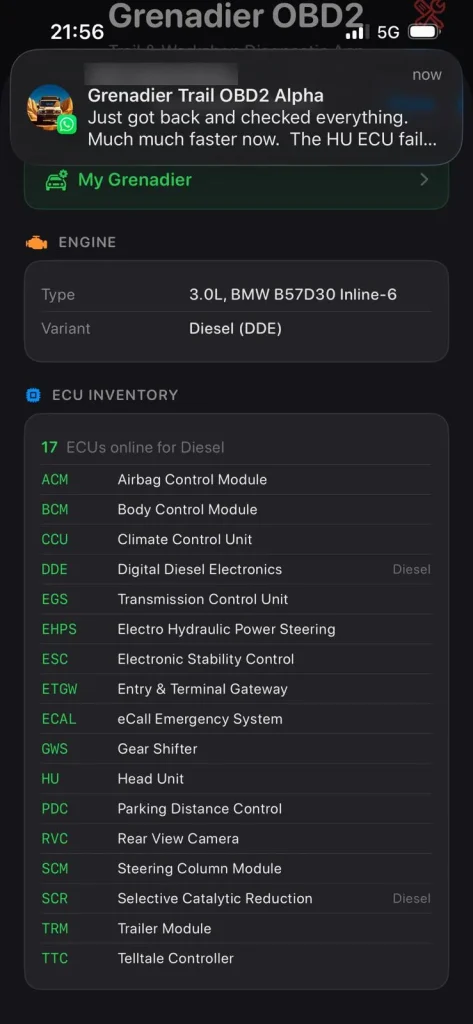
At one point, our discussion turned to something some owners and potential owners simply assume. The Grenadier’s straight-six petrol and diesel engines originate from BMW. Common sense therefore suggests that, if an engine related problem develops during a journey, a nearby BMW workshop should at least be able to connect diagnostic equipment and point the owner in the right direction. According to Dieter, the situation is considerably more complicated.
Although the vehicle incorporates components from several respected manufacturers, the Grenadier is not merely a collection of familiar parts assembled beneath a new body. The electronic architecture has been developed specifically for INEOS Automotive, allowing the vehicle’s many control systems to communicate as a single platform rather than as unrelated components. In layman’s terms: recognising the engine is one thing, understanding the vehicle surrounding it is quite another.
When I later raised the same question while collecting a Grenadier from INEOS Automotive, one member of the team answered without hesitation: “You wouldn’t take a Mercedes with a Renault engine to a Renault workshop,” he said. “BMW are the same.” It was a simple analogy, but an effective one. For expedition travellers, this is a difficult-to-ignore red flag.
Listening to Dieter, I found myself thinking back to Balsdon’s Cape-to-Cape expedition. During our interview, we’d spoken about a cracked windscreen, a broken radiator, the intermittent warning lights, and the sheer physical punishment the vehicles had endured over almost a month in the most inhospitable terrain. What we didn’t discuss was the risk running quietly beneath the surface all along: what if one of those Grenadiers had suffered a significant electronic fault deep inside Angola? Something buried within the electronic architecture itself. Who would have diagnosed it? How quickly could it have been understood? What would recovery have looked like if the nearest authorised service partner lay thousands of kilometres away?
Those questions are uncomfortable. They are also entirely reasonable.
My conversation with Dieter was voicing what many others are thinking. That mechanical dependability and expedition confidence are not necessarily the same thing.
Only then did he begin explain his solution. The interface is remarkably restrained. Ignition on, engine off. Connect a Bluetooth OBD adapter. Allow the application a few moments to communicate with the vehicle. It quietly begins gathering information that, until now, has largely remained hidden from owners.
Vehicle identification, production data, control units, service information, and system status all appear within seconds. That impression was echoed almost immediately by one of the first alpha testers. Michael Gierlings described the application as “well thought out and very usable,” admitting that what surprised him most was how quickly it connected to the vehicle and produced a complete overview. More importantly, “You can tell Dieter is building this app because he actually understands what Grenadier owners want to see.” That may be the strongest endorsement the software could receive. Not because it praises the application itself, but because it recognises the thinking behind it.
One feature in particular stuck with me. At first glance, generating a PDF diagnostic report sounds almost mundane. Almost. Imagine planning a routine service several weeks in advance. Instead of arriving at the workshop and attempting to describe intermittent warning messages from memory, the owner emails a comprehensive diagnostic report before leaving home. The technician already knows the vehicle identification number, the recorded faults, the software versions, and the systems requiring attention. Parts can be ordered in advance, workshop time planned more effectively, and, where appropriate, software updates prepared before the vehicle even arrives. The software strengthens the relationship between owner and workshop.
Example Diagnostic Report Click any page to enlarge.
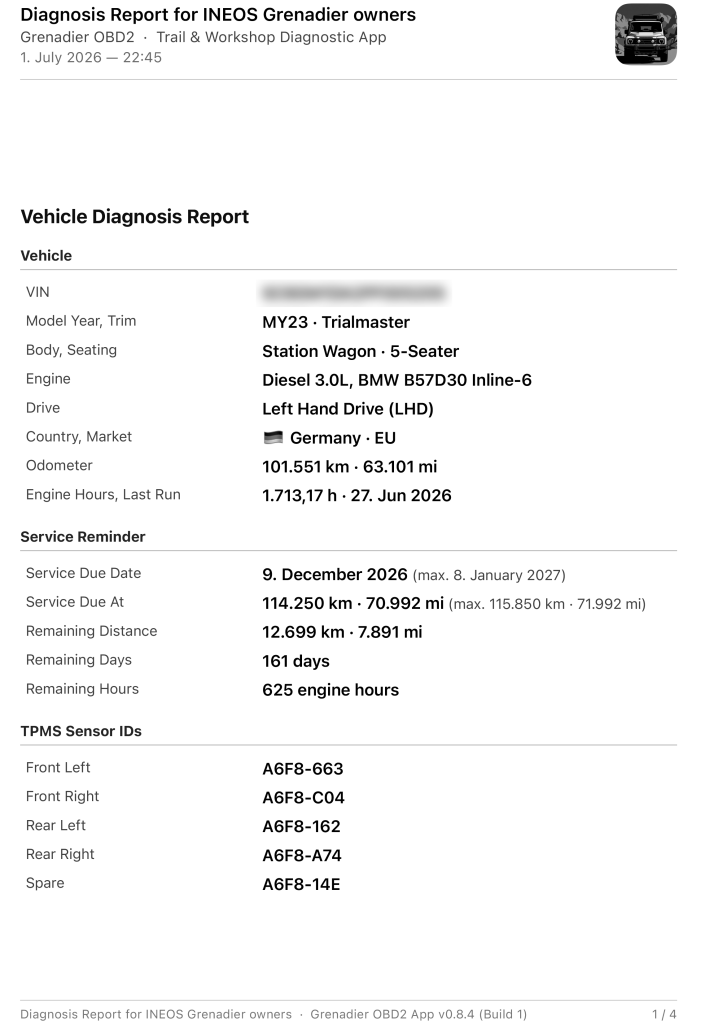
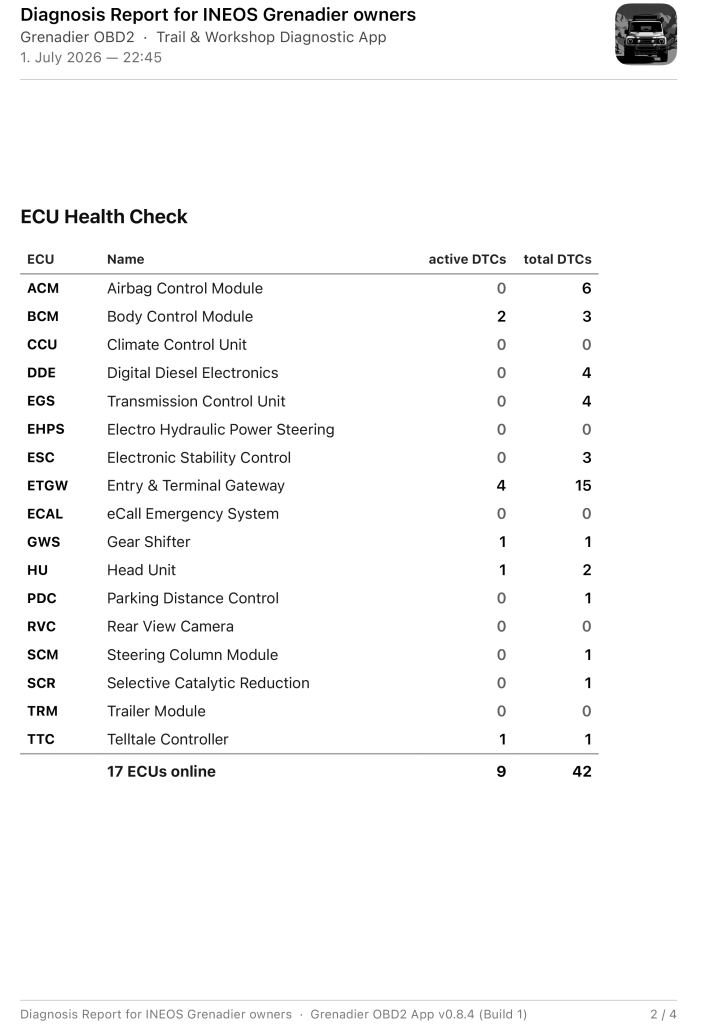
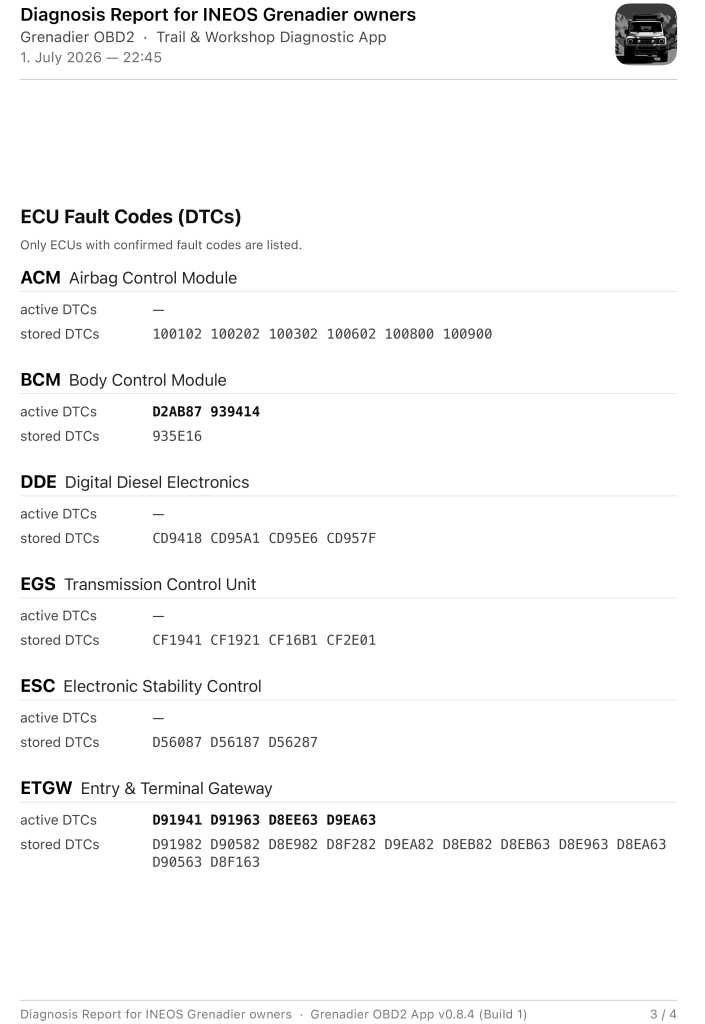
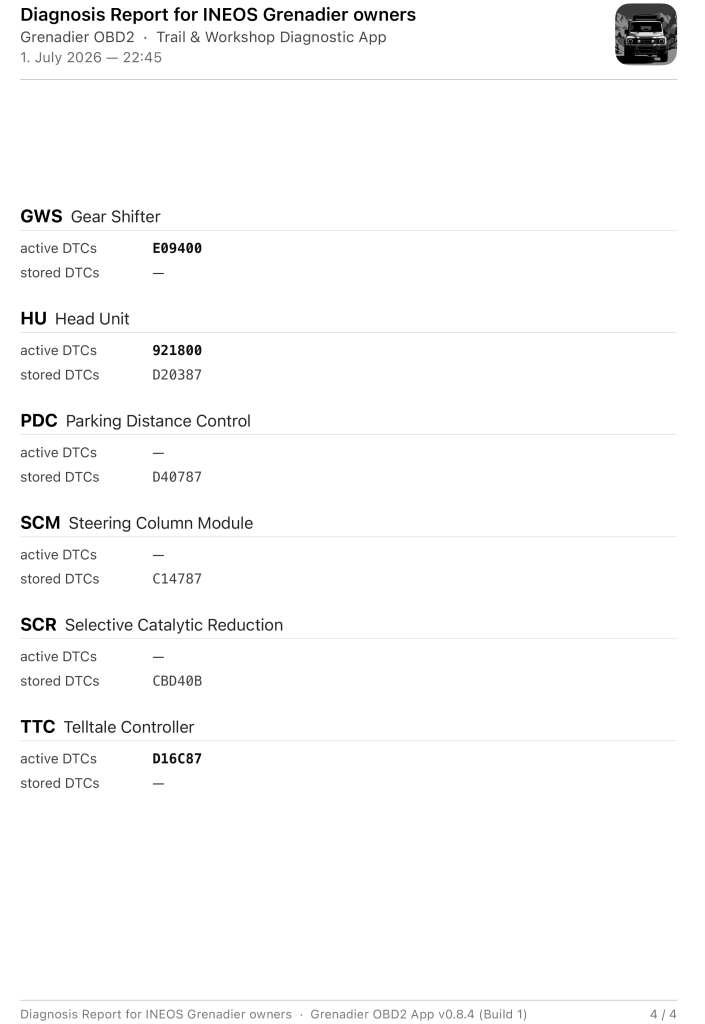
Anyone who has spent time crossing remote regions understands that uncertainty often becomes more exhausting than the fault itself. A warning light with no explanation can occupy the driver’s thoughts for days. Understanding why the light is on changes that completely. Knowing which systems have reported faults, recognising whether those faults are historic or current, and being able to document them before deciding how to proceed, transforms guesswork into informed judgement. It does not guarantee the journey will continue, nor does it pretend every fault can be resolved beside the track. It simply allows decisions to be based upon evidence rather than assumption. That, ultimately, is what Dieter has built. Not a workshop tool. Not a tuning device. Not a means of bypassing the manufacturer’s safeguards. But a service tool that belongs in the same conversation as recovery gear, navigation equipment, and medical supplies. Not because you expect to need it, just because you might.
As our conversation drew to a close, I found myself thinking less about software and more about the Grenadier itself. Thankfully, every successful expedition vehicle eventually reaches a point where the manufacturer is no longer the only source of knowledge. Look at the original Defender and the Land Cruiser. Neither became the vehicles we love today through factory engineering alone. Their reputations were shaped by the communities that grew around them. Perhaps the Grenadier is simply beginning the same process, and that is ultimately in the manufacturer’s interest.
What Dieter has created does not conflict with INEOS Automotive’s responsibilities in relation to functional safety, cybersecurity, emissions legislation, warranty obligations, and product liability. His philosophy is remarkably simple: understand first, change nothing. That is a surprisingly mature position, and one that feels entirely consistent with the vehicle itself. The Grenadier’s development team has done its level best not to create the most technologically and electronically dependent four-wheel drive on the market (as far as legislation permits). They aimed for durability and predictability; a vehicle intended to carry people far beyond the places where recovery trucks are commonplace. The very existence of projects like Dieter’s makes the Grenadier an even stronger expedition platform, not a weaker one. The further a vehicle travels from its manufacturer’s network, the more valuable independent understanding becomes. For years, Land Rover owners have quietly packed an IIDTool alongside recovery straps and spare drive belts. Nobody regards it as a performance accessory. It is simply part of sensible preparation.
I have no doubt certain Grenadier owners will view Dieter’s application in exactly the same way. Not because they expect electronic faults, but because, like any of us, they accept electronics are inevitable in modern vehicles and can go wrong. Confidence comes from knowing what to do when it does.
This project marks another step in the Grenadier’s evolution from a newly launched four-wheel drive into a mature expedition platform supported not only by its manufacturer, but also by the people who use it in the way it was always intended.
If you want to know more, you can find Dieter Reuter on Facebook or reach out to him directly by email: dieter.reuter@me.com
Part 2 looks at how the system works in practice and what it can actually tell you in the field. Read Part 2 here.