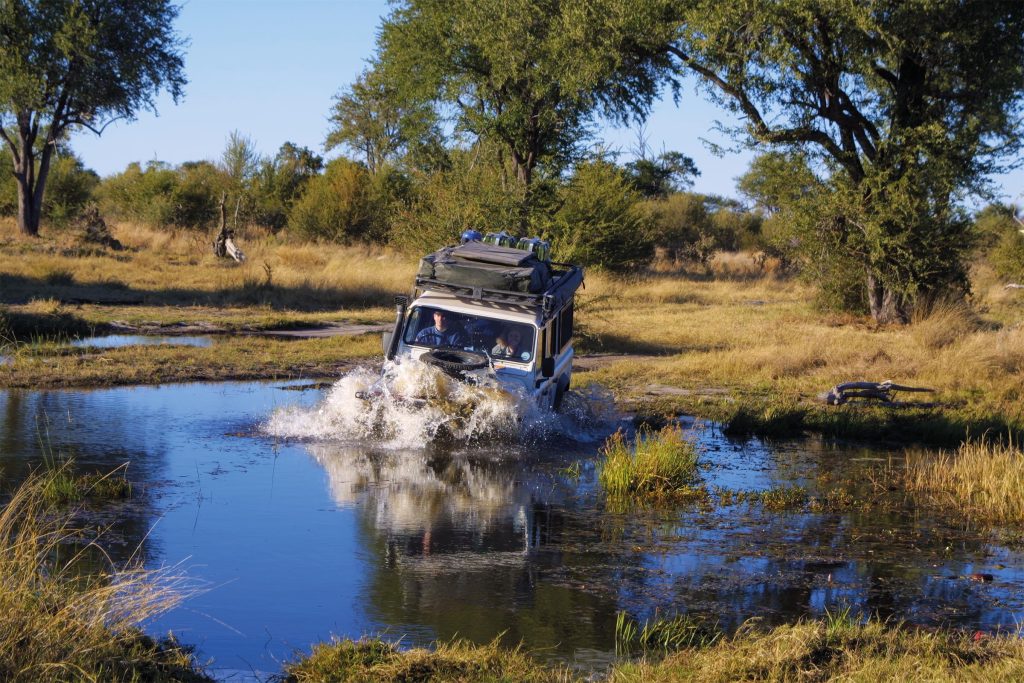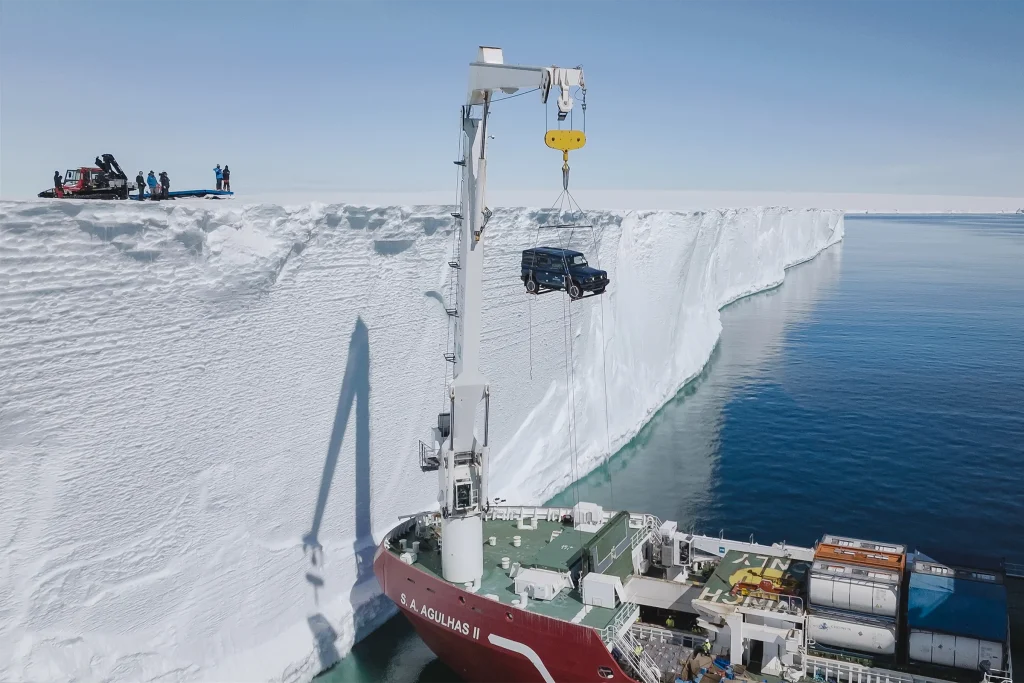
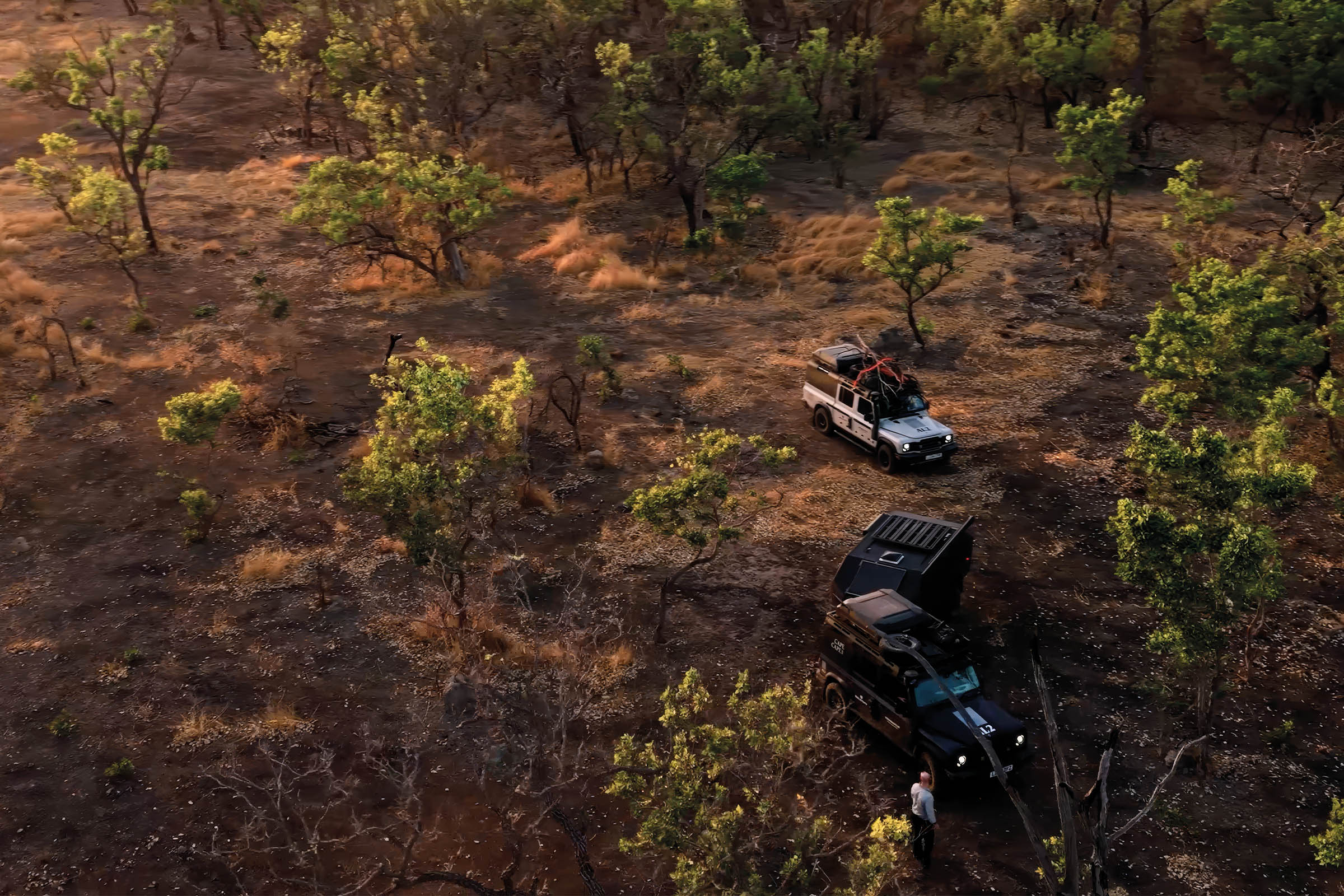
The Quartermaster hammered through the darkness like a freight train laden with urgency.
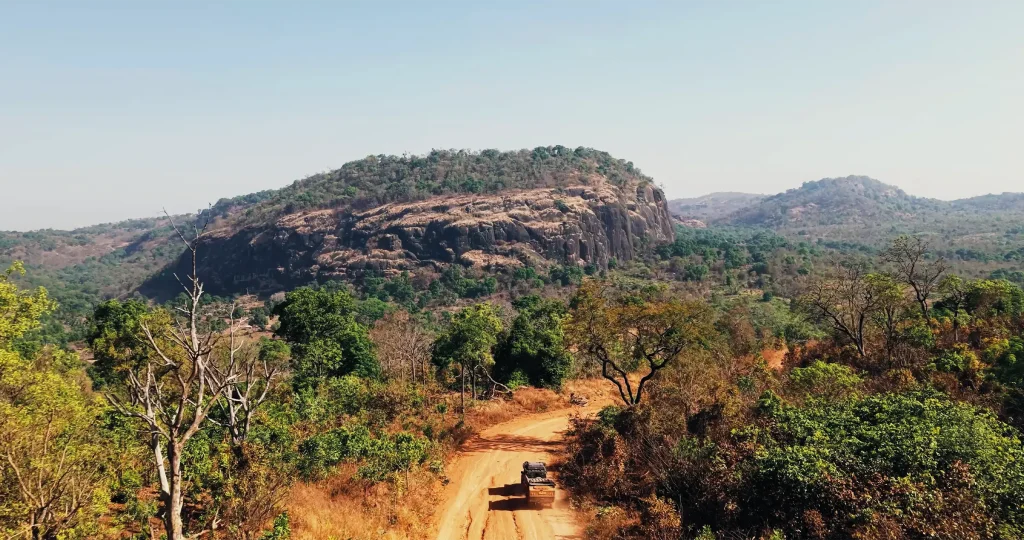
Somewhere ahead, beyond the reach of the headlights, the second Grenadier drifted in and out of the Angolan night. Dust hung in the beams like smoke. The road—if it could still be called a road—rose and collapsed beneath the tyres in endless waves of corrugations, potholes and broken asphalt. Every impact sent another shock through the chassis. Another metallic thud. Another reminder that both men and machines were being pushed far beyond the comfortable limits of modern travel.
Inside the vehicle, bodies slept where they could. One man folded awkwardly across the rear seat. Another sat half-awake beside the driver, waiting for his turn at the wheel. The dashboard glowed amber and red with intermittent warnings that had long since become part of the expedition’s background noise. Outside, the temperature still hovered brutally high despite the darkness. Somewhere beyond the roadside scrub, livestock wandered freely. Pedestrians appeared suddenly from nowhere. Trucks loomed without lights. The convoy pressed south regardless.
There were still roughly four thousand kilometres left to Cape Agulhas. The record was beginning to slip away.
“We drove the last four thousand kilometres non-stop,” John Balsdon told me afterwards. “I was sleeping on the back seat if I wasn’t driving. It was pretty brutal on the cars. It was pretty brutal on the people.”
The people, he admitted quietly, suffered more than the vehicles.
That single sentence perhaps says more about the reality of overland endurance than any polished expedition film or carefully curated social media post ever could.
By the time the convoy crossed Angola, the romance had long since evaporated. This was no longer the cinematic overlanding fantasy of open horizons and campfire reflections. The expedition had become something far rawer: a rolling exercise in attrition measured in border crossings, exhaustion, time pressure, and endurance. Every lost hour mattered. Every bureaucratic delay became a threat. Every decision carried weight.
And yet, in many ways, this journey had begun long before the first Grenadier pointed south from Europe.
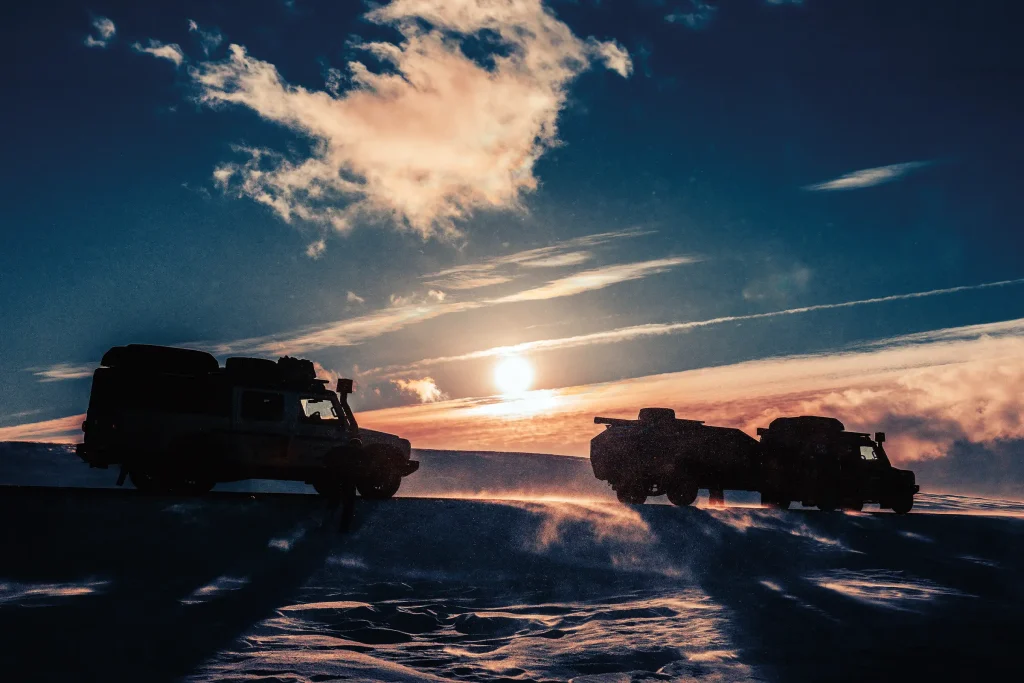
Seventy years earlier, another Brit had set out towards Africa with a similarly irrational idea. In 1955, Richard Pape left London in a modest Austin A90 Westminster and drove towards Cape Town through a continent that, at the time, still represented one of the last true overland unknowns for European motorists. The journey would later become immortalised in his book Cape Cold to Cape Hot, a work that still occupies near-mythical status amongst generations of overlanders and expedition travellers. Pape crossed the Sahara in summer heat, crashed heavily, nearly died, carried firearms for protection, and continued south regardless in an era before satellite navigation, mobile phones, air-conditioned cabins or online route planning.
It was a different Africa. A different world. But recognisably the same instinct.
For most people, turning sixty marks the beginning of a gradual retreat from discomfort. The edges soften. The ambitions narrow. Adventure becomes something viewed retrospectively through old photographs, half-forgotten stories, and increasingly careful plans. Comfort quietly replaces uncertainty. Modern life encourages it. After decades spent working, travelling, building careers and accumulating responsibilities, few people arrive at that stage in life and decide the logical next step is to point two heavily loaded four-wheel drives towards Africa and attempt to cross two continents faster than anyone before them.
John Balsdon is not entirely wired like most people.
“I’m in the fourth quarter,” he said during our conversation, speaking with the calm matter-of-factness of somebody who has already spent considerable time thinking about the subject. “I turned sixty last year and I need to crack on.”
There was no drama in the statement. No manufactured bravado. If anything, it sounded more like a quiet acceptance that time itself had become increasingly valuable.
Long before Cape-to-Cape entered his thinking, Balsdon had already lived several distinct lives. Photography arrived first. His mother worked professionally behind the camera and, as a boy, he learned the craft the old-fashioned way inside a school darkroom, long before digital photography simplified the process into endless instant repetition.
“I’ve been doing photography since I was twelve,” he explained. “I had a dark room in my comprehensive school.”
The camera never entirely disappeared from his life, even when another path gradually took precedence.
That second life unfolded inside the upper reaches of international corporate law. For twenty-five years, Balsdon worked as a partner at three of the largest law firms in the world. The work carried him across fifty-four countries and through some of the most politically and commercially complex environments on earth. He spent a decade living in Russia between 1996 and 2006, during the years when post-Soviet capitalism often resembled controlled chaos more than structured business. Travel became constant. Pressure became normal. Complexity became routine.
“It was champagne law,” he laughed. “Not just the pay. The work itself. World-class projects in very difficult places.”
There is a temptation when writing about people who abandon successful corporate careers to frame the story as some kind of spiritual escape from a life they secretly hated. The reality here feels more nuanced than that. Balsdon genuinely enjoyed the world he operated in.
“I was passionate about my corporate life as well,” he said. “I really, really enjoyed it.”
But enjoyment and permanence are not always the same thing. Eventually, the relentless pace began colliding with a different realisation: that there were other parts of life waiting impatiently beyond conference rooms, airports, and billable hours. Three thousand working hours a year leave little room for much else. The structure that delivers success can also quietly consume everything surrounding it.
At some point, he simply decided the innings were over.
“I thought it was time to declare one hundred and ten not out and go off and do something else.”
That “something else” slowly evolved into a combination of photography, travel and increasingly ambitious overland journeys. In 2016, a trip to Kenya with a medium-format camera changed the trajectory permanently. The landscapes of the Laikipia plateau—vast, textured, and impossibly layered beneath East African light—became the catalyst for the work he now produces through his photography platform, Always Look Twice. The name itself feels revealing.
Most modern life is built around speed. Most photography now exists to be consumed in seconds. Most travel has become acceleration disguised as experience.
Balsdon’s photography instead revolves around observation, patience, and detail. Much of his fine-art work is captured from helicopters or aircraft, producing enormous landscape images filled with texture, abstraction, and scale. They are photographs that demand time from the viewer rather than rewarding distraction.
Which, in hindsight, makes Cape-to-Cape an almost perfect contradiction. The journey demanded precisely the opposite instincts.
There would be no lingering in markets. No waiting for perfect light. No disappearing for two hours to study a landscape properly. No luxury of observation. Only movement.
Border crossings quickly consumed entire afternoons. Delays multiplied constantly. Every hour lost at customs reappeared later as pressure somewhere further south. The mathematics of the record became increasingly oppressive: thousands of kilometres still remaining, yet fewer available driving hours every day.
“What they say didn’t survive contact with the enemy,” Balsdon admitted with a smile.
The enemy, in this case, was reality itself. And reality arrived hard.
PREMIUM ARCHIVE
Continue reading with OverlandEurope membership
This article forms part of more than ten years of independent overland journalism. Learn what membership includes and how it opens the complete archive.
Already a member? Log in to continue.
Log in to continue reading
Enter your member details to continue reading this article without leaving the page.
The complete OverlandEurope archive, published independently since 2016.