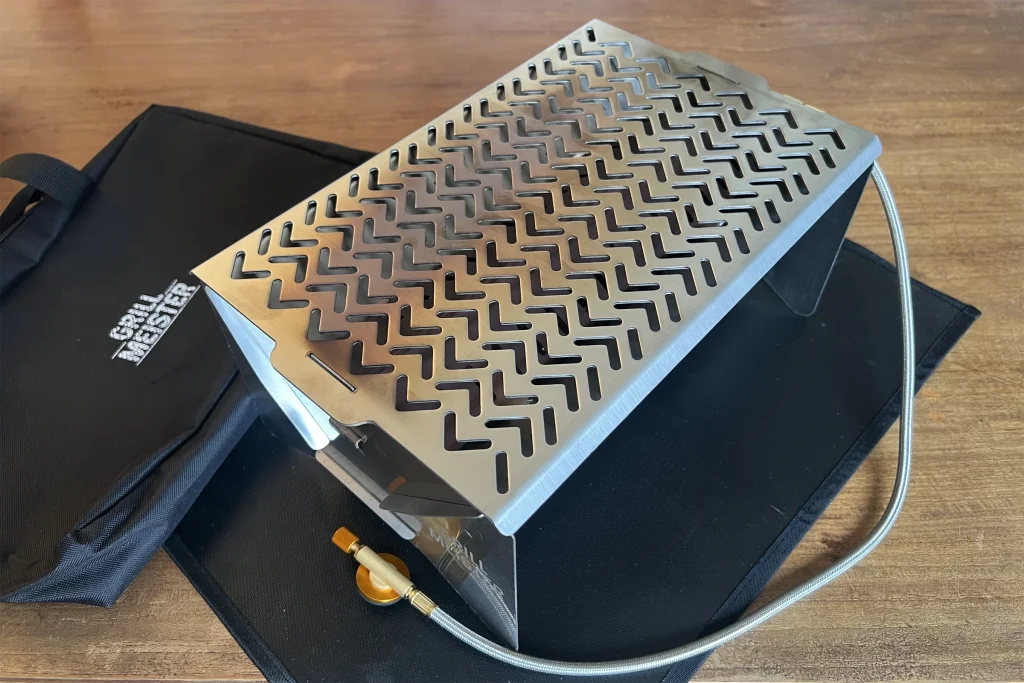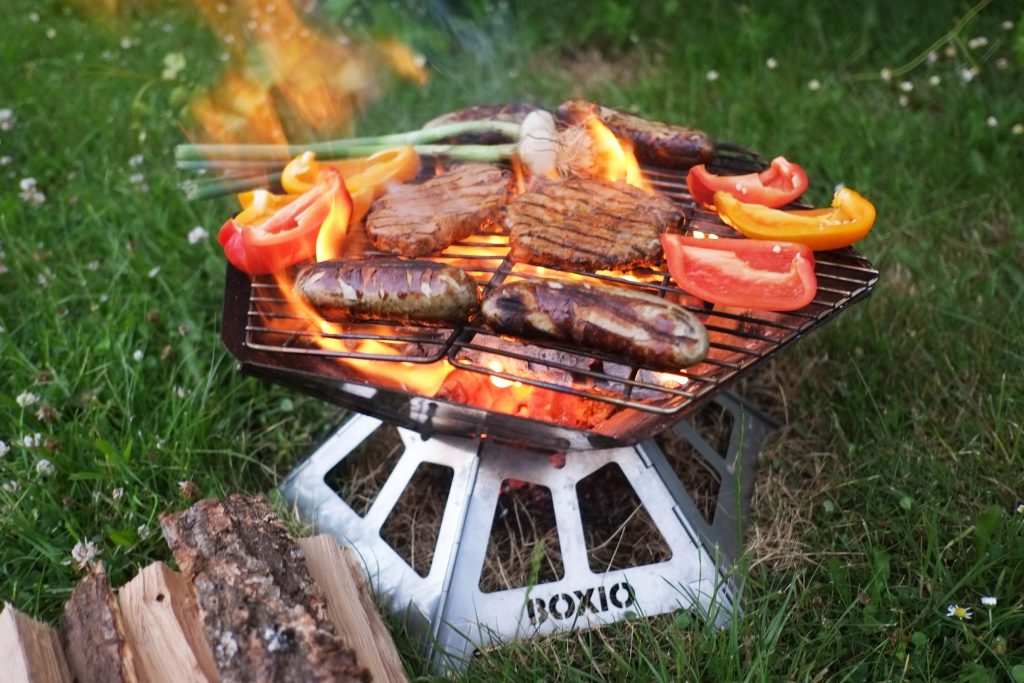
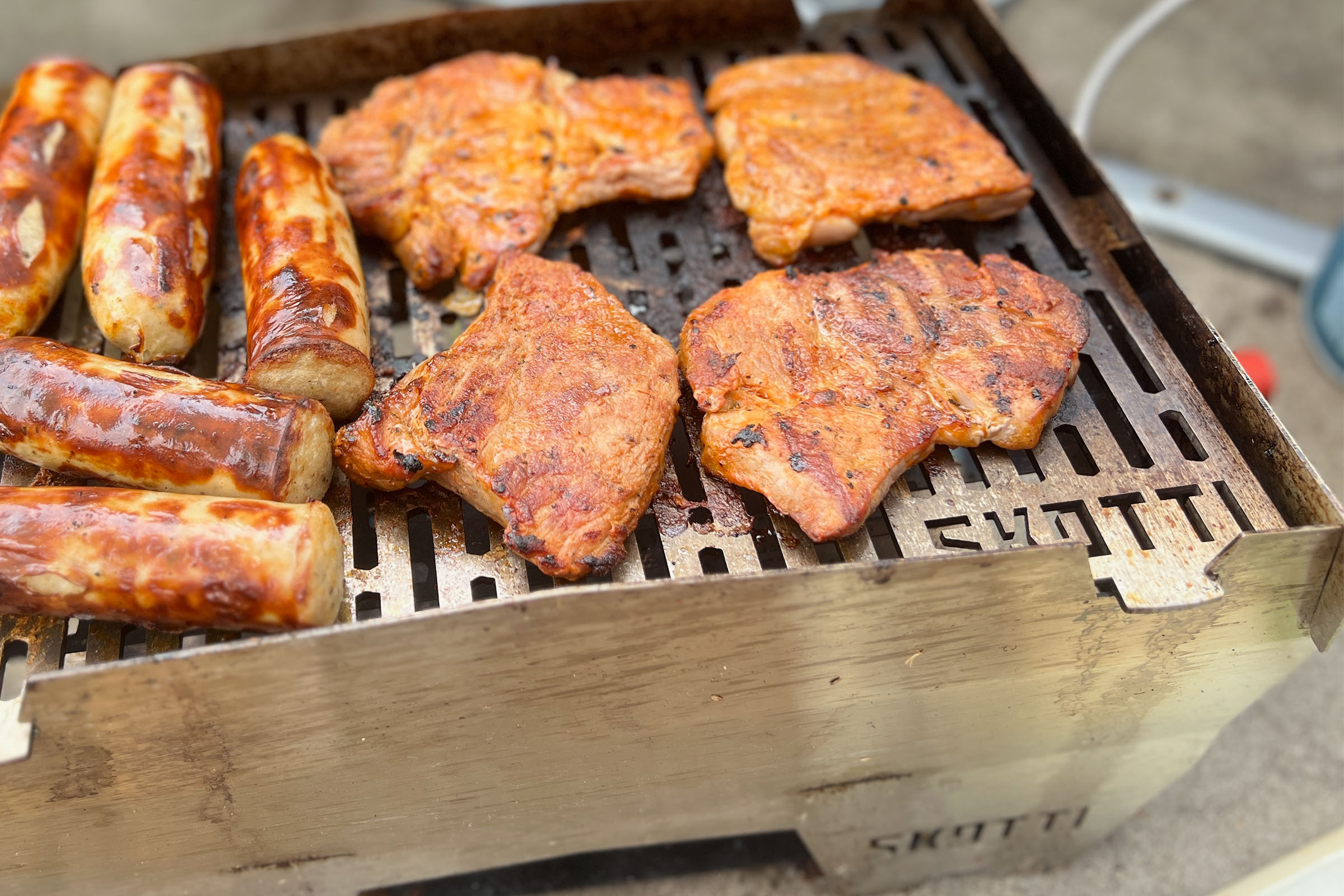
This article is born from a long overdue product review, hastened by a steady stream of promotional posts in my Facebook and Instagram feeds. However, there’s a difference: while promoted videos and limited-time discounts maybe good for the manufacturer, the brand new, shiny products only tell part of the story. So here we are, with a SKOTTI Grill that has completed several laps of the sun and has proof of concept written all over it.
The heat marks are probably the first thing you will notice compared to the short-lived experience posts. A faint bloom of straw burnishing on all surfaces. On a new grill this would read as a flaw. On this one, it reads as a logbook. Sausages on an Alpine pass. Chicken thighs in the garden under an umbrella because we weren’t going to let the rain dictate our dinner plans. Baby potatoes—more times than I can count because they’re a staple side dish that everyone loves and they’re so simple.
I wanted to give the SKOTTI a chance to win me over, because Stefan has shared his appreciation on many an occasion and I don’t know anyone who has more variants of barbecues than him. It seems that every time he travels or visits a show, he returns with his latest must-have grill. Yet despite all the new kit, the SKOTTI remains a stalwart in his van.
As with all good products, it all began with a problem that needed a solution. In this case, it was a fisherman’s answer to the problem of having an open flame where they aren’t welcome and collapsed into a package that fits in the door pocket of a car or the side of a pannier. Nine pieces of 1.1mm stainless, no plastic anywhere on it, assembling in the time it takes to find a flat surface to put it on. That part of the pitch has held up. What I wanted to know, after several years of service and a great many meals, is whether the rest of it does too.

Assembly is genuinely intuitive, and it gets faster the more you do it, though I’ve stopped caring whether it’s forty seconds or ninety. If I’m setting up to cook, that’s simply part of the preparation, in the same way filling a kettle is part of making tea. Countdown done: ignition. There’s a pilot hole at the end of the burner tube that takes a lighter cleanly, first time. An important detail, because everything else about this grill depends on that first small success.
Where I expected more, if I’m honest, was the heat distribution. There’s a noticeable gradient along the burner tube, hottest where the gas enters and cooler toward the far end. A detail the manufacturer’s website addresses as something to accept in this style of gas grill. After a while, I learned to treat this as a feature: sear at the hot end, then slide the meat down to hold and finish gently while the next piece takes its turn over the flame. It’s a technique the grill sort of teaches you once you stop fighting it. However, I’ll admit the cooking surface isn’t generous enough to make the two-zone approach feel like more than a modest trick rather than a genuine capability. How much heat you actually get also depends on how full the cartridge is. Pressure drops as the gas does, so patience becomes part of the recipe, particularly toward the end of a canister.
But none of this stopped the food from tasting great. The potatoes, tossed in oil with rosemary, garlic, and a good crack of pepper, then left to catch and blister, have become something close to a ritual at this point. Sausages, beef, pork, chicken: with a bit of practice reading the gradient, everything comes off tender, properly seared, without the char or dryness that an uncontrolled flame gives you if your attention wanders. A flat tray placed on top of the grate opens up a different register entirely, including a full English breakfast with bacon, eggs, mushrooms, black pudding and onions. This means it stops being a lunch-and-dinner tool and starts covering what many call the most important meal of the day, too. I did try heating water for coffee once, but soon gave up on the idea. The burner tube runs longer than any pot’s diameter, so most of the flame is heating the surrounding air rather than the water, which felt like a waste of gas for the sake of caffeine I could make another way.

SKOTTI, in its simplest configuration, is a gas grill and it behaves like one. A low flame will duck and gutter in a stiff wind, same as any gas flame would, and I’ve made my peace with building a windbreak from whatever’s to hand, such as a Zarges box or the car itself, rather than treating it as something specific to Skotti. What the gas-only nature does buy you, though, is the ability to cook in places where an open flame would be a genuine liability, provided the local rules allow it: some fire bans cover any flame, gas included, so that’s always worth checking before you rely on this instead of caution. Dry scrub, fire-restricted regions in high summer, the kind of ground where you’d think twice about charcoal, a sealed burner still needs the same respect for wherever you’ve parked it.
Cleaning has never once been a chore worth griping about. Residue that’s properly stuck comes off with a ball of wire wool and a bit of elbow grease, and the steel takes the abuse without complaint. That resilience extends to the whole structure. Even after years of regular use, there is no warping anywhere. Everything still sits precisely as designed, still assembles and disassembles the way it did from the outset. The heat marking, the patina you can see in any well-used photo of one of these, is exactly what SKOTTI themselves will tell you to expect, and it’s cosmetic rather than structural. To the creator’s credit, there are no seams or hinges that can jam or bind. It couldn’t be simpler.
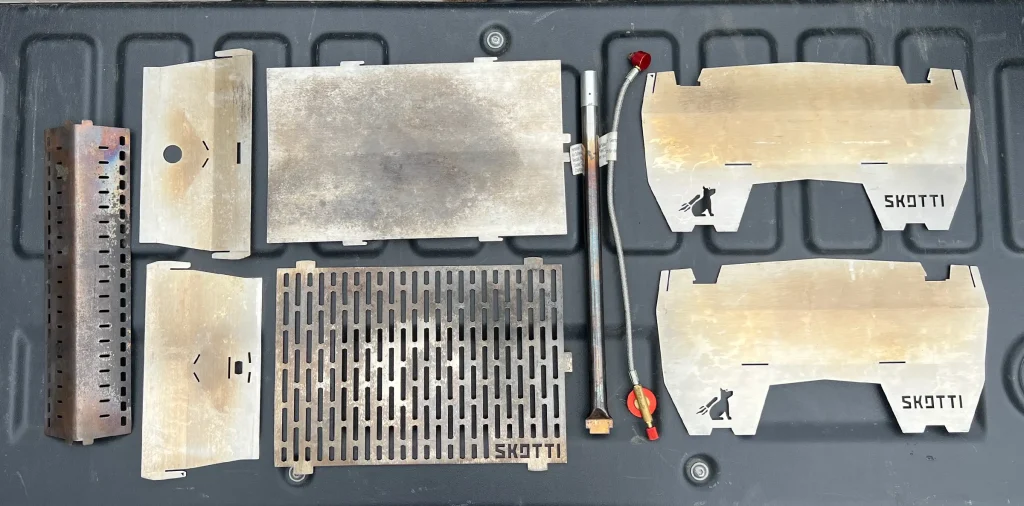
Portability is where the design earns its keep most convincingly. Flat-packed into its own pouch it’s genuinely laptop-sized, and the weight has never registered as an issue for anything motorised … car, motorbike, doesn’t matter. I’d think harder about it on a bicycle tour, where every gram gets weighed against muscle power, and I wouldn’t take it on a long-distance backpacking trip at all.
At €169 for the basic set in its pouch, without any accessories, this sits at a price which, when set against a multi-year service record with no structural failures, is difficult to call anything other than fair value.
That verdict on value is based on the set as I’ve used it, not necessarily as it ships today. Looking at the current version on Skotti’s site, the drip tray has evolved into a proper tray that takes water or sand, rather than the simpler angled sheet I was working with. It’s a sensible update, and it reads to me like a company still listening to the people who bought its earlier grills rather than one simply chasing new customers with each release. There’s also a wider accessory range now: bundles, add-ons, some of it aimed, I’d guess, at bringing existing owners back into the fold rather than only converting new ones. I haven’t tried any of it (yet), so I won’t pretend to know whether it’s worth the outlay; what I can say is that the base unit, on its own, has proven itself sufficient for one-night stopovers, spontaneous get togethers with friends or family, or an ordinary Tuesday evening barbecue in the garden … regardless of season or weather and without needing anything else strapped to it other than gas.
The reputation this grill has built over the years turns out, on close and repeated use, to be an accurate one. It does what it says and the tarnish proves it.
from €169 | skotti-grill.eu