A river you have photographed for years, stops being a subject and becomes a backdrop. The Rhine at Cologne had been that for me: grey water, a barge working upstream, the cathedral or a bridge somewhere in the frame. I fish there as well as photograph it, and from the riverbank, both depend on the water being where you expect it. This autumn, it became a subject again because it was no longer the shape I knew.
By late September, the gauge at Cologne, which averages around three metres, had fallen to 40 centimetres, the lowest reading since records began. The numbers meant less to me than what they did to the view. The water had drawn back from both banks, leaving a wide margin of stone, pale, dry on top, and dark where the river still reached it. In places, the far bank looked close enough to wade to, if it were not for the shipping channel running down the middle. Anyone who walked along the Rhine this autumn would have seen what the margin held. Shells by the thousand, crunching underfoot like a shingle beach. Mobile phones lying in the silt. Dead hairy crabs on their backs. Catfish of a fair size, stranded and dried stiff in the sun.
And, in a few places, stones with dates cut into them.
On 30 September I drove to the point where the Wupper runs into the Rhine in Leverkusen, a short way north of Cologne, to see whether there was anywhere left to fish. I also had a newspaper photograph open on my phone. It showed a boulder on the riverbed with a year carved into it, and a line of trees behind. The gauge at Cologne read 42 centimetres that day, two above the record it had set at the previous weekend.
I walked the waterfront for some time until I met an elderly woman. When I asked whether she knew of the stones, she said yes and that I was on the wrong side of the Wupper. I retraced my steps as far as the pontoon bridge, crossed, and walked down the other bank to the Rhine, heading out into the nearest groyne field. Groynes, or Buhnen in German, are low walls of quarried stone built out from the bank at an angle. They push the current towards the middle so that the river keeps its own channel deep, and the water between them, the Buhnenfeld, is usually slack, which is why anglers seek it out. This year, it was a field in the literal sense: a long grey apron of cobbles, rocks, and shells.
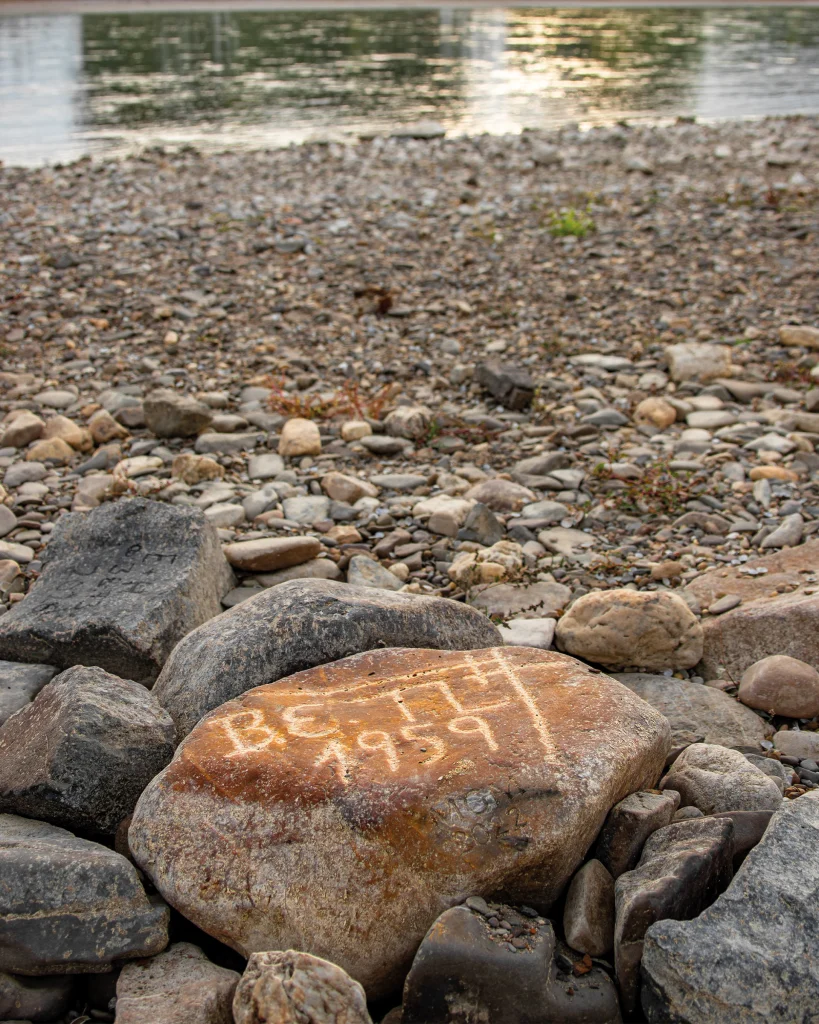
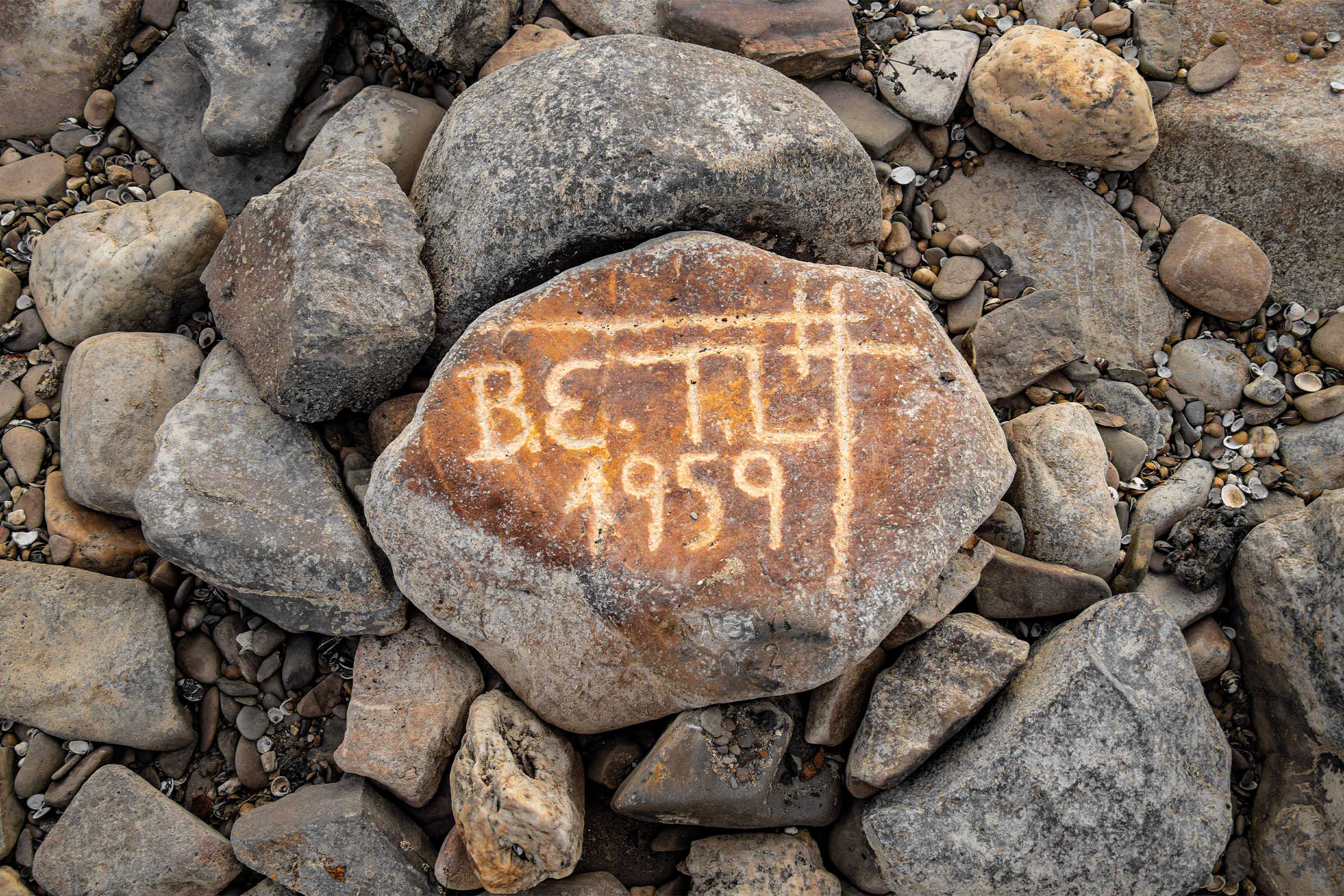
A newspaper photograph is a map if you know how to read one. The stone in it meant nothing on its own, but the tree line behind it was fixed, as was the angle between the trees and the water. I held the phone up and walked until the trees in the picture and the trees on the bank lined up. The boulder was a few steps away. It was rounded and brown, weathered to a patina, with letters pecked into the upper face: B. E. T. L. Below them: 1959. Someone had ruled a line above the letters and down one side, like the corner of a frame. The shallow letters and numbers are only really distinct when the light hits them at the right angle, and they faded as I moved around the stone. In the lower corner were fainter scratches, fresher, in another hand. A photographer who had been to the same stone in August, and posted her pictures to Wikimedia Commons, recorded the stone as commemorating the drought of 1959 and added to in 2022.
A few paces on lay a slab of red sandstone. H.S, it said, then 2003, then D.P. A third stone was a different kind of object altogether: a pale, angular block, the letters cut deeper, and the grooves already dark. TR in one corner. FEUSER 2026 in the other, boxed in with two ruled lines. Then a date, 14.08.26, and below it two rows of initials joined with plus signs, K+B+E+J and R+L+M+J. Eight people, by the look of it, and one of them willing to sign in full.
These are hunger stones, Hungersteine in German, and the name is meant literally. A hunger stone is a rock in a riverbed that shows only when the water is exceptionally low, and that someone has marked with the year. There were always two reasons to dread seeing one. A river that low meant a summer without rain, and a summer without rain meant a failed harvest. It also meant that the boats had stopped, and for centuries the boats were how grain, coal, and firewood reached the towns. The stone needed say no more than the year. The rest was understood.
The custom is best recorded on the Elbe. At Děčín, in the north of what is now the Czech Republic, a large basalt boulder lies against the left bank, and years have been cut into it since 1417. That first date and another, 1473, have been worn away by anchoring ships. The oldest that can still be read is 1616, and after it come 1707, 1746, 1790, 1800, 1811, 1830, 1842, 1868, 1892 and 1893. In August 1876, a newspaper in nearby Teplitz reported that the Elbe was a sadder sight than at any time since 1842, with hunger stones standing out along its length and the steamers on the Bohemian stretch laid up. A paper in Linz, in the dry summer of 1893, called the stones a peculiar kind of meteorological chronicle, kept in the years before weather stations existed.
The Děčín stone also carries the sentence that made it famous: “Wenn du mich siehst, dann weine.” If you see me, weep. It is quoted every time a European river runs low, and nearly always given the date 1616. The newspapers of the time tell it differently. Elbe boatmen had long told of a stone further upstream, at Těchlovice, said to read “We wept, we weep, and you will weep.” During the drought of 1904, a local shipowner, a man named Mayer, liked the tale enough to have a line of his own cut into the big stone, along with the date and his name. It took a photograph to settle what the Těchlovice stone actually said. One was taken that summer, and the wording turned out close enough: Whoever once saw me wept, and whoever sees me now will weep.
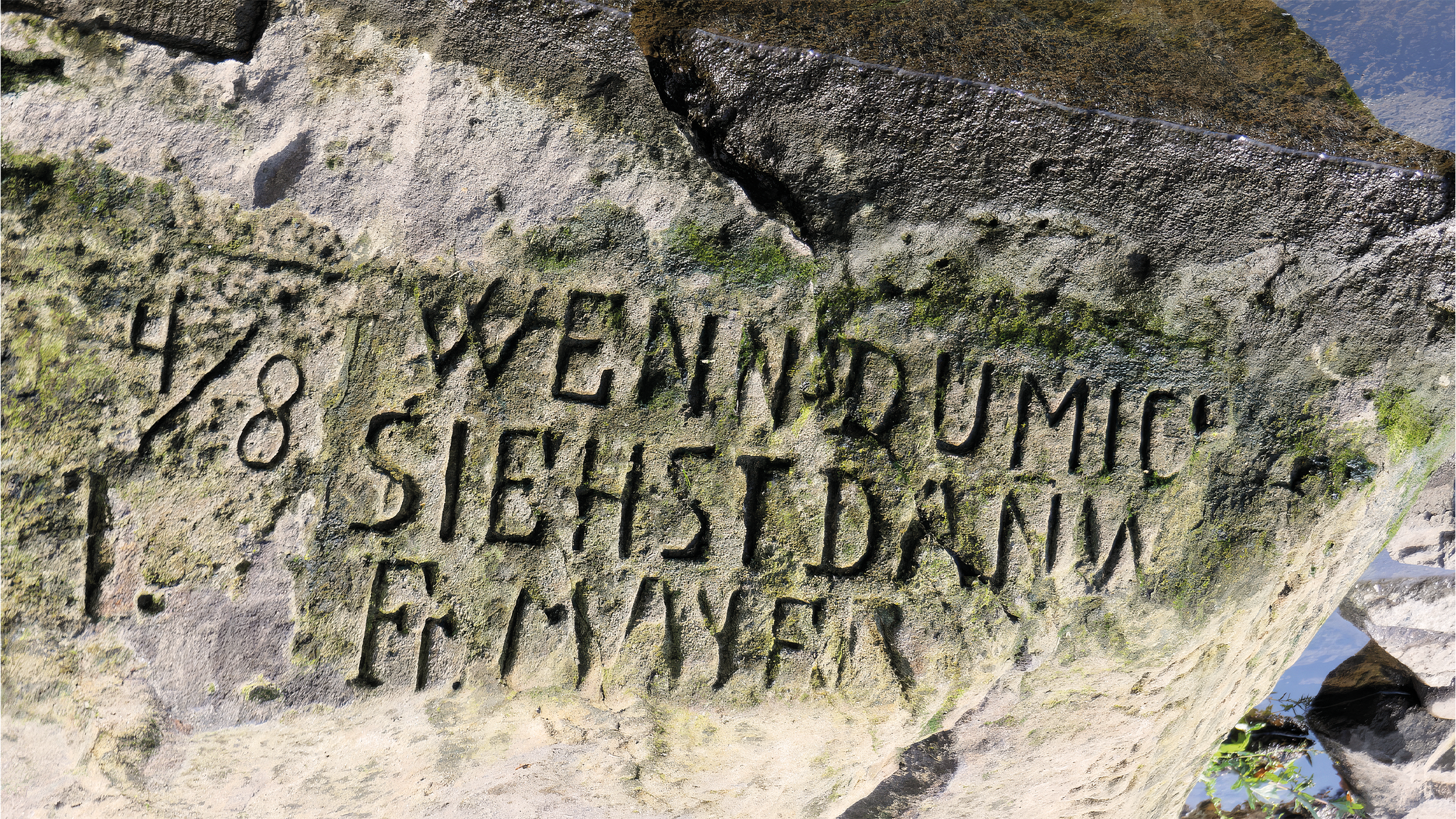
People walked out to Mayer’s stone every day, the papers called it a pilgrimage, and the waterways office built a wall around it. The stone went round the world on picture postcards. One of them, posted that August and now in the public domain, is the work of E. Rennert, a photographer in Aussig. It shows the stone half out of the water, with a woman in a long dress and a broad hat standing beside it, holding a parasol. The years and the famous sentence stand out in white, as though someone had gone over them for the camera; and somebody has written 16/8 04 across the corner in pen. Around 1938, a pump manufacturer added a line in Czech telling a girl not to weep and moan, but to water the field. The years on that stone go back five centuries. The sentence dates back to 1904.
On the Rhine, the best-documented stones lie in Rheindürkheim, near Worms, well out from the riverbank and close to the shipping channel. The oldest reads Ano 1857. Beneath it, cut deep, is Hungerjahr 1947 … and that one does not record a drought. According to the city of Worms, it recalls the winter of 1946 to 1947, when the Rhine froze over for sixty kilometres, the barges stopped, and neither coal nor food reached those who had little of either. Below that, someone added 1959, and later 1963. A second stone says Anno 2003.
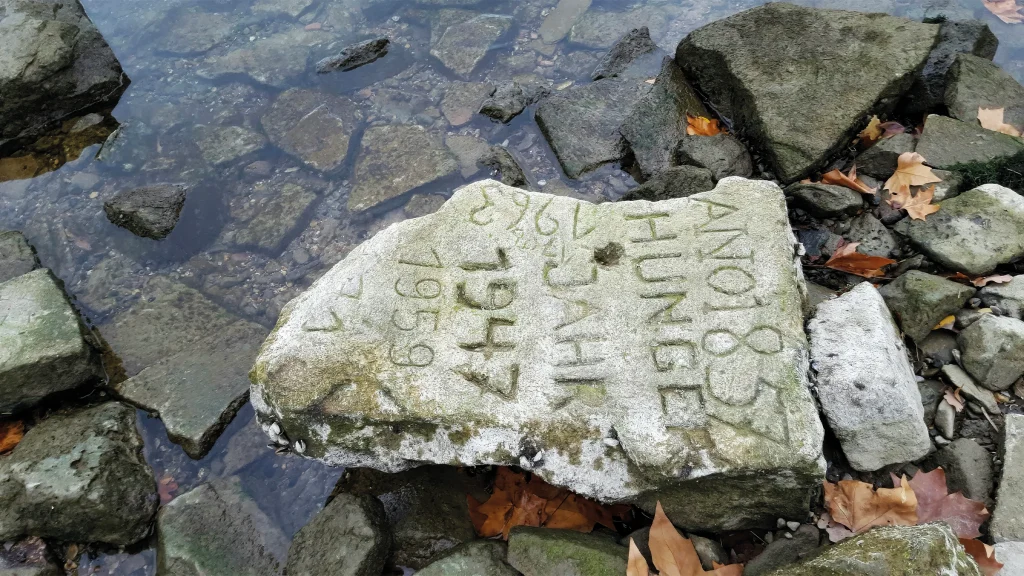
So the dates at the mouth of the Wupper were not peculiar to it. 1959 was dry enough to be cut into the Worms stone and into another on the Weser. 2003 brought what was then the hottest German summer since 1901, and at Cologne, the gauge sank to about 80 centimetres, a record that stood until 2018, when it fell to 69. This year, it went to 67 on 1 August and to 45 on 16 August, and the pale block was signed within two days of that low. On 27 September, it reached 40. B. E. T. L. stood on the same gravel 67 years before me, doing what H.S and D.P did in 2003, as well as somebody called Feuser in 2026. None of them wrote a warning. They recorded that they had been there.
There used to be a fourth stone at this spot, but it is no longer in the river. In August, two members of staff from the Haus der Geschichte in Bonn, the museum of German history since 1945, lifted a half-metre-long block weighing at least fifty kilograms out of the riverbed near the Wupper and took it away. It is inscribed 3.8.1973, with the letters E and H, and with a fresh 2026. It now stands in the part of the museum given over to the present day. Nobody can say whether the stones always lay where they were found or if they were placed there by people who wished to maintain the tradition. Either way, the stones near Cologne are not medieval. The earliest date reported there is 1959.
Nobody in Leverkusen will go hungry in 2026 because the Rhine is low, and it would be easy to treat the stones as a curiosity. But the mechanism they record still works. The gauge figure is not the depth of the river; at 40 centimetres, the shipping channel in Cologne still holds about a metre and a half. That is enough to float a barge, but not enough to load one. A vessel that normally carries 2,500 to 3,000 tonnes was moving 250 to 300 at the end of September, according to the logistics firm Rheincargo, and the port at Niehl was all but idle. Upstream at Kaub, the shallowest point of the Middle Rhine, the gauge went below zero for the first time since measurements began. The ferry between Weiß and Zündorf stopped running, and the state lifted the Sunday driving ban on lorries until the end of October, so that the roads could carry what the river could not.
For anyone holding a rod, the loss is closer to hand. What dries out first is not the channel but the edge: the gravel shallows and the side arms, where young fish grow and most of the feeding is done. The water that remains is warmer and holds less oxygen, and the fish crowd into it. Upstream, the anglers’ association of Baden-Württemberg has joined the conservationists of NABU in arguing against dredging the channel any deeper, on the grounds that a river cut down for barges takes the water from the land beside it. Even the debris underfoot has a history. The clams whose shells covered the groyne field are Asian, and reached the Rhine around 1986; they are now the commonest mussel in it. The hairy crabs are Chinese mitten crabs, first recorded in Germany in 1912, and believed to have arrived in ships’ ballast.
The riverbed is not as harmless as it looks, either. In early August, the authorities in Cologne warned people to keep off the exposed bed. Low water uncovers what the war left in the river as readily as it uncovers anything else, and a shell that has lain in silt for eighty years is not safe for having done so.
At the time of writing, the first days of October promise rain, here and further south, and the river is expected to swell, albeit slowly. Autumn and winter will have to do the rest. The groyne field will fill, the barges will load again, and I will be back on the bank with a rod. B. E. T. L. will go back under, as it has for most of the last 67 years, and until the next dry summer; the only way to read it will be a photograph.